6.2.2 A proliferation of cost estimation handbooks adds unnecessary complexity
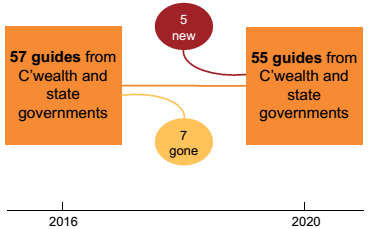
In 2016, we at Grattan Institute were startled to discover there were more than 50 current guideline documents and handbooks on how to estimate project costs in Australia. Four years later, not much has changed: seven guidance documents have been retired, but another five have sprung up in their place (Figure 6.2).
Figure 6.2: There are 55 guides in Australia for estimating the cost of transport infrastructure projects
Source: Grattan analysis of Australian Commonwealth and state guidance.
Ultimately, all cost estimates use some combination of four tools: expected value, sensitivity analysis, probability pricing, and reference class forecasting, often referred to as benchmarking or validation (see Appendix B). But the handbooks that are current today present these same basic tools in a wide variety of ways, and they are inconsistent in terms of which tools they recommend, and in how they guide the user through the relationships among the various tools.
It is not obvious why Australian jurisdictions need different approaches to the same basic tools. Not only are the core tools presented in inconsistent ways, but the data that would be required to use the tools properly is not available to cost estimators. In particular, probability pricing and reference class forecasting rely on historical cost outcomes.
It would be prudent for governments embarking on megaprojects, with the associated complexity and risk, to ensure a high competency standard for those involved; for instance, registration as a cost engineer or risk engineer.
Recommendation 7 The Commonwealth Government should provide model guidelines that states and territories may adopt or adapt, that recommend a consistent approach to measuring and managing project risk, including a statement of seniority where specific guidelines would otherwise conflict with one another. |