Review documents - Whether sufficient time was allowed for approvals, commencement, and completion of the tender process
From the review documents (e.g. the Procurement Plan/Strategy), we defined the tender process as comprising the following key procurement steps:
• Release of the EOI document;
• EOI Evaluation to identify shortlisted bidders;
• Issue of the RFP to shortlisted bidders;
• RFP Evaluation;
• PB announced;
• PB Negotiations; and
• Contract Signed.
We noted the above key steps are consistent with usual approaches taken during a PPP procurement process, reflecting the market's expectations.
In terms of key tender timelines, we focussed on the following procurement milestones to compare TG's tender process with international benchmarks:
• Time given to the market to prepare EOI and RFP responses;
• Time allocated for PB negotiations; and
• Overall procurement timelines from the date the EOI was issued to the date the Contract was signed with the PB.
Our summary of the key TGP timelines along with comparative international benchmarks is set out in Figure 7 (below). For international benchmarks, we have used Australia and Canada as they have comparable PPP frameworks and approaches but noting these international jurisdictions have very established PPP markets and projects when compared to New Zealand.
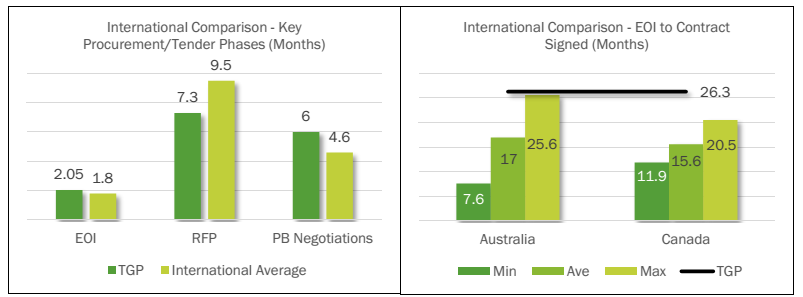
Figure 7: Key TGP Procurement/Tender Milestones vs International Comparisons
With Figure 7 in mind, our observation from the review documents is:
• The TGP's overall procurement timeline of 26.3 months was at the upper end of the comparative international benchmark, but recognition should be given to the scale and complexity of TG and this was New Zealand's first road availability PPP project;
• EOI preparation time given to the market for the TGP was just over the international average;
• RFP preparation time was under the comparative international benchmark;
• PB negotiation time was over the comparative international benchmark; and
• The TGP's combined time of 15.35 months for EOI, RFP preparation and PB Negotiations was slightly less than the equivalent international average of 15.6 months.