Pre-contract cost estimate increases
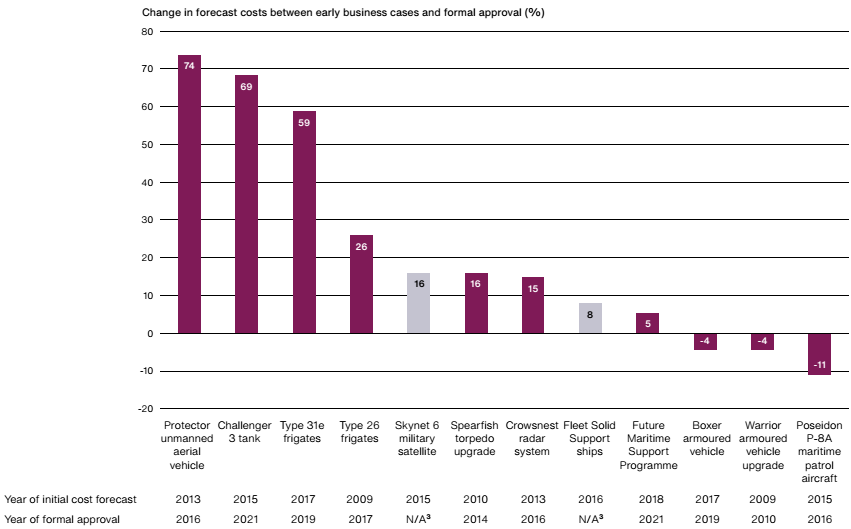
2.5 Figure 4 on pages 25 and 26 shows how cost estimates for programmes covered in this report changed prior to the Department committing to the full costs of the programme. It is to be expected that programme costs will evolve as better information is available. However, it means that the Department may be committed to a programme before the true costs become clear. Nine programmes out of the 12 with available data saw forecast cost increases between their early business cases and main investment decision, with the costs of three growing by 59% or more. In addition, in four of the nine programmes with available data, the cost estimate approved at the main investment decision point exceeded the worst-case scenario modelled at the point of initial approval. Analysis carried out by the Department in October 2020 confirmed that large increases during this stage were common. The efforts necessary to accommodate these increased cost estimates within the programme and across the portfolio can have a significant influence on the contracting approach, by prioritising cost avoidance over the other elements, and on relationships between the Department and suppliers.
Figure 4 Changes in the forecast cost of the Ministry of Defence's major equipment programmes between early business cases and formal approval The forecast costs of nine of 12 of the Ministry of Defence's (the Department's) equipment programmes increased before the formal approval point
Notes 1 This figure shows the difference between procurement costs anticipated in early business cases and those approved at the main investment decision. In some cases, the number of units the Department intends to purchase changed, affecting the cost of the programme. The Department increased the size of the Protector unmanned aerial vehicle fleet from 13 to 16 aircraft in order to increase its capability. Conversely, the cost of the Poseidon programme would have increased, and the cost of the Challenger 3 and Type 26 programmes would have increased further, had affordability constraints not led to the Department reducing the quantity of units. The Department reduced the number of P-8A Poseidon maritime patrol aircraft from 12 to nine, and the Challenger 3 fleet from 227 to 148 tanks. It increased the number of Type 26 frigates from 10 to 13, before reducing the number to eight. 2 For the Future Maritime Support programme, the Department's current forecast includes an additional year compared to its estimate in its early business case, to reflect letting of contracts one year later than it originally planned. 3 The Fleet Solid Support and Skynet 6 programmes have not yet reached the approval to manufacture stage for substantial elements of the programme, although the Skynet 6A project is on contract. For these programmes, the figure shows the current cost forecast denoted in grey columns. 4 This figure omits programmes where we were not able to assess cost increases between early business cases and the main investment decision. The New Style of IT (Deployed), Astute and Complex Weapons programmes and Morpheus project have taken an incremental approach to approvals, meaning that elements of the programme were, and will be, formally approved at several different points in time, while the Ajax armoured vehicle element of the Armoured Cavalry programme has changed scope over time. We do not have access to the A400M business cases due to the age of the programme. The Future Combat Air System Technology Initiative programme is a research and development programme, so does not have comparable parameters to the other programmes we examined. Source: National Audit Office analysis of Ministry of Defence documents and data |