Building Condition
2.10 Building Condition has been assessed through completion of a detailed survey of building fabric and M&E plant at each school. Data has been captured for individual assets on a component by room level (e.g., the floor finish within one classroom, or a single hot water circulating pump present in a plant room).
2.11 This data has been utilised to inform the Lifecycle cost model, Backlog Maintenance costs and the Residual Value.
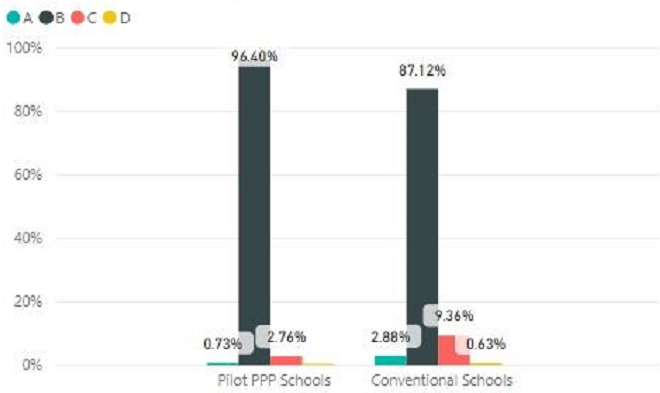
2.12 Figure 2.6 summarises the condition survey findings with each component assessed on a condition A-D basis (Table 2.5).
Table 2.5 - Condition Ratings
Rating | Condition |
A | In new condition. |
B | Meets required standards and is aging as expected with no anticipation of replacement or repairs in the short-term relative to the life of the asset. |
C | Asset meets the required specification standards but is expected to fail within the short term (20%-30% of life expectancy). May also be indicative of obsolete or worn assets with difficult to locate spare parts. |
D | Asset fails to meet the required standard under the terms of the contract and required immediate (within 1 year) replacement or repairs. |
Figure 2.6 - Condition Breakdown by Group
Condition breakdown by group - Fabric
Condition breakdown by group - M&E
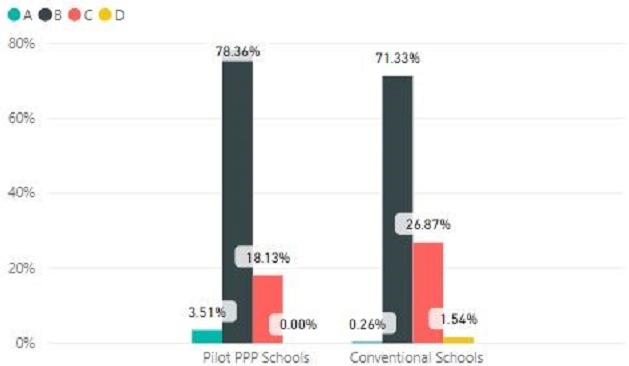
2.13 The Conventional Schools have a significantly higher proportion of assets assessed as condition C and D. This indicates a generally poorer condition and the need for greater spend on asset maintenance and replacement. For the Pilot PPP Schools Bundle, the percentage of poor condition assets would be expected to be low given the maintenance contracts and Lifecycle funding in place.