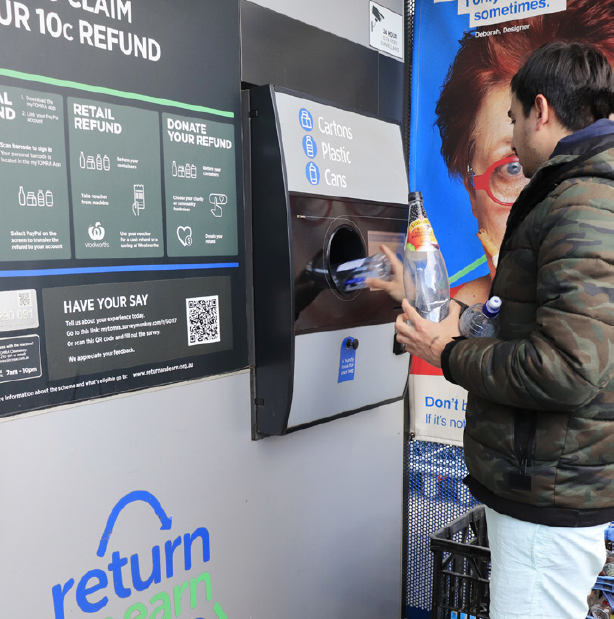
9.1 Valuing resources to enable a circular economy
9.1 Recommendation Avoid waste, improve resource recovery and build demand and markets for recycled products by integrating the circular economy in national waste policy and infrastructure projects. Proposed sponsor: Department of Agriculture, Water and the Environment Supported by: Department of Industry, Science, Energy and Resources | ||||
When this should impact: |
| Where this should impact: |
| |
| 9.1.1. Increase understanding of the role of consumers in the circular economy through community education on responsible waste behaviour. Proposed lead: Department of Agriculture, Water and the Environment Supported by: State and territory environment departments | |||
| Increase understanding and compliance through community education which highlights the benefits of landfill diversion and the importance of correct separation of materials for household waste collection services. Proposed lead: State and territory environment departments Supported by: Local governments | |||
| Increase consumer understanding by reviewing the effectiveness of current recycling labels. Proposed lead: Department of Agriculture, Water and the Environment Supported by: State and territory environment departments | |||
| Increase consumer participation in product stewardship by applying these recycling label insights to a broader range of materials and products. Proposed lead: Department of Agriculture, Water and the Environment Supported by: State and territory environment departments | |||
| 9.1.2. Reduce the impact of plastic on the environment by implementing the National Plastics Plan. Proposed lead: Department of Agriculture, Water and the Environment Supported by: State and territory waste departments | |||
| Increase plastic recycling by providing guidance on aligning requirements and timeframes between state and territory governments and industries. Proposed lead: Department of Agriculture, Water and the Environment Supported by: State and territory waste departments | |||
| 9.1.3 Build support for the circular economy and embed circular practices by developing a circular economy roadmap for the infrastructure sector, including annual progress reports. Proposed lead: Department of Agriculture, Water and the Environment Supported by: Department of Infrastructure, Transport, Regional Development and Communications, CSIRO: Commonwealth Scientific and Industrial Research Organisation, Department of Industry, Science, Energy and Resources | |||
| Improve uptake and consistency in the use of recycled and recyclable materials in infrastructure and construction projects by incorporating targets in building and design codes. Proposed lead: Department of Infrastructure, Transport, Regional Development and Communications Supported by: Department of Industry, Science, Energy and Resources | |||
| Ensure greater use of recycled materials within government infrastructure projects by developing procurement targets and timelines. Proposed lead: State and territory infrastructure departments Supported by: State and territory chief engineers | |||
| Support the piloting and early deployment of innovative technologies and processes through structured co-investment programs for products incorporating recycled materials. Proposed lead: State and territory infrastructure departments Supported by: State and territory chief engineers | |||
| 9.1.4 Support co-location of circular economy facilities by undertaking collaborative land-use planning. Proposed lead: State and territory planning departments Supported by: Local governments | |||
| Improve waste infrastructure in Rural and Remote Areas by developing land-use plans that include resource recovery facilities. Proposed lead: State and territory planning departments Supported by: Local governments | |||
| Improve levels of service in Rural Communities and Remote Areas by identifying locations for hub-and-spoke models of waste management services. Proposed lead: State and territory planning departments Supported by: Local governments | |||
| 9.1.5. Reduce organic waste to landfill through mandating local council food organics and garden organics (FOGO) collection services. Proposed lead: State and territory waste departments | |||
| Reduce waste to landfill and emissions by introducing FOGO collection and processing for households when renewing existing waste management contracts. Proposed lead: Local governments Supported by: State and territory place management agencies | |||
| Increase uptake of FOGO services and encourage positive waste behaviours by implementing ongoing education and communications with households before and during the life of the collection service. Proposed lead: Local governments | |||
| Account for local factors such as geography, climate and storage when developing place-based guidance on FOGO implementation for local government. Proposed lead: State and territory waste departments Supported by: Local governments | |||
| Enable FOGO collection in apartments by amending complying development provisions to allow retrofitting for facilities in existing apartments, and by incorporating FOGO and other collections in the design of new builds. Proposed lead: State and territory planning departments Supported by: Local governments | |||
| Reduce mixing of waste by commercial and industrial operators by creating an opt-in program to separate organic waste into a different stream Proposed lead: State and territory waste departments | |||
| Develop end markets for reprocessed organics by developing a FOGO recovery strategy that tests new uses for recovered materials. Proposed lead: State and territory waste departments, state and territory industry departments Supported by: Department of Agriculture, Water and the Environment | |||
| Improve distribution of FOGO material to regional areas for further processing and use by consolidating collected FOGO material. Proposed lead: State and territory waste departments Supported by: Local governments | |||
| Avoid food waste across the supply chain by working with industry to connect with alternate markets for the quick and direct sale and redistribution of FOGO. Proposed lead: State and territory waste departments | |||