Extreme weather events and a changing climate
The scale and risk of this uncertainty was evident in 2019 and 2020.
During 2019, Australia experienced its warmest year on record, with the annual national mean temperature 1.52°C above average.
In the same year, national rainfall fell to 40% below average. This extraordinarily low rainfall period is comparable to that seen in the driest periods in Australia's recorded history, including the Federation Drought 1895-1903 and the Millennium Drought 1997-2009.5
Figure III.1 shows how Australia's drought levels and patterns have changed over the past two decades.
In addition, the national annual accumulated Forest Fire Danger Index in 2019 was the highest since 1950, when national records began.6
The 2019-2020 bushfire season burned over 17 million hectares of land across New South Wales, Victoria, Queensland, the ACT, Western Australia and South Australia.
This was larger than the combined area burned in the Black Saturday bushfires in 2009 and the Ash Wednesday bushfires in 1983.
During the 2019-2020 bushfires, 33 people lost their lives, including nine firefighters and were the largest in terms of area burned.7
Figure III.2 shows Australia's bush fire events have increased in size in recent years.
Figure III.1: Australia was drier in 2017-2020 than during the Millennium Drought
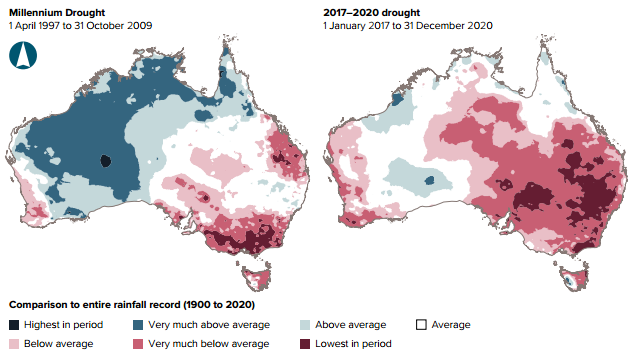
Rainfall deciles from April 1997 to October 2009 (left) and from January 2017 to December 2020 (right). These maps show where rainfall was above average, average or below average for the period compared to the entire national rainfall record from 1900 to 2020.
Source: Bureau of Meteorology (2021)8
Figure III.2: Some of Australia's worst bushfires have occurred in recent years
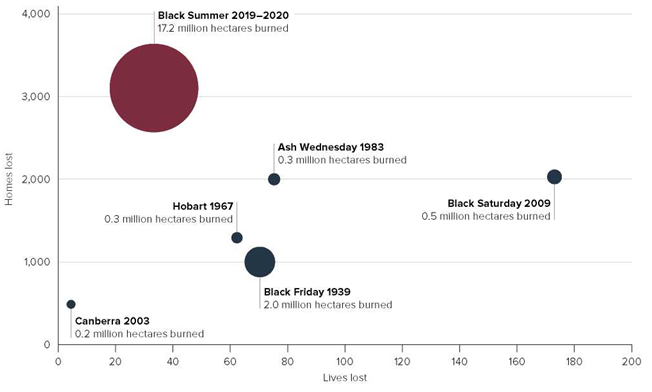
Note: The size of each circle represents the total area burned.