Taking a place-based approach has multiplier benefits for the community
A place-based approach A place-based approach aims to connect infrastructure decision-making with the needs of a community at a local level. It takes a cross-sectoral view of the interrelated infrastructure and amenity needs of a place and identifies how and when these should be delivered.5 |
Making place the starting point for infrastructure planning provides a clear lens for identifying the different needs of Australia's communities, highlighting how integrated planning will benefit particular locations and initiatives.
This increases governments' capacity to deliver targeted infrastructure that meets specific local needs while creating wider opportunities for productivity, growth and high quality of life.
Communities benefit directly because place-based infrastructure should offer value for money, is well-used and meets local needs. In addition, place-based infrastructure generally delivers multiple benefits beyond its primary purpose in the form of compounding impact, or collective impact.
For example, a new railway might allow for increased housing density near train stations. To support this increased density, these homes then require supporting infrastructure, such as schools, hospitals, parks, telecommunications and municipal services such as water, waste and electricity. If these are all planned together using place-based principles, the pace and benefits of growth will be magnified.
Another example is planning that incorporates future needs by reserving land within, or near, housing for anticipated future schools, public transport and social infrastructure. This mitigates the need to disrupt communities and pay elevated rates to secure the same land in the future.
The Victorian Government's Framework for Place-based Approaches A framework for place-based approaches outlines a common language and methodology to embed the concept of place across Victorian Government programs. The Framework champions the role of place as a focal point for government that can help: • support civic engagement by focusing effort on communities and their strengths • develop evidence-based policy that is holistic by breaking down barriers between sectors and portfolios • support preventative, cost-effective responses as investment can be targeted to where it will have the greatest impact.6 |
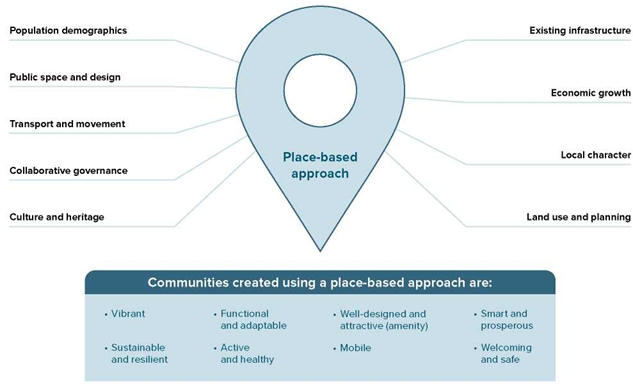
Figure 1.1 outlines some of the key components of taking a place-based approach to infrastructure, showing how it creates vibrant and sustainable communities that people want to live in.
To reach its full potential, place-based planning must begin with a shared vision that is developed jointly between current and future stakeholders, including the local community. The vision should then be managed through collaborative governance.
This vision should be based on a holistic picture of interrelated elements in that place. Elements might include its growth potential, public spaces and design, local character, land use and planning, population demographics, movement and transport, and critical social infrastructure.
Beyond its immediate impact on planning and development decisions, the concept of putting place first informs a recommended overall approach to, and central reference point for, sector-based reforms. It has been applied throughout the 2021 Plan, both in the proposed reforms and in the supporting narrative, particularly in the Sustainability and resilience, Transport and Social infrastructure chapters.
Figure 1.1: Putting place at the centre of infrastructure planning creates more liveable communities