Elevating place in the planning hierarchy
Place is emerging as one of the key factors that must be considered when planning community-centric, high-value infrastructure.
Infrastructure projects deliver a broad range of benefits to enable better outcomes for people and places.
State and territory governments are increasingly focusing on specific places for renewal and regeneration, either establishing place-centric development corporations or providing existing agencies with clear, place-based priorities.
A growing awareness of the transformational potential of putting place first is reflected in the institution of place-based planning in most jurisdictions. As Figure 1.2 shows, this ranges in scale and focus.
In New South Wales, for example, Placemaking NSW is managing multiple diverse precincts in areas such as The Rocks and Sydney Olympic Park, as well as the Hunter and Central Coast, while the Greater Sydney Commission focuses on metropolitan Sydney.
In addition, the remit of government land organisations around brownfield developments (land that has already been developed and has infrastructure) is being tightened. They are increasingly tasked with improving housing affordability and fostering urban renewal, in line with state planning strategies.
This work is underscored in Movement and Place frameworks in New South Wales7 and Victoria,8 which put places (and the local community) at the centre of planning transport infrastructure. This focus on the user, and the catalysing role of infrastructure at a place level, is a departure from the traditional 'predict and provide' approach to planning based on extrapolating past trends.
" Infrastructure projects deliver a broad range of benefits to enable better outcomes for people and places. "
The Transport chapter details a commitment to a cross-sector, place-based approach to integrating land use and transport. This kind of planning is informed by the relationship between population flows, spatial structure in towns and cities, and emerging mobility patterns and behaviours.
Infrastructure Australia supports a spectrum of place-based assessments and governance structures. This approach mirrors the varying degrees of complexity and coordination required to realise place-based outcomes in a specific location.

Figure 1.2: A place-based approach is evident across different levels of the planning hierarchy
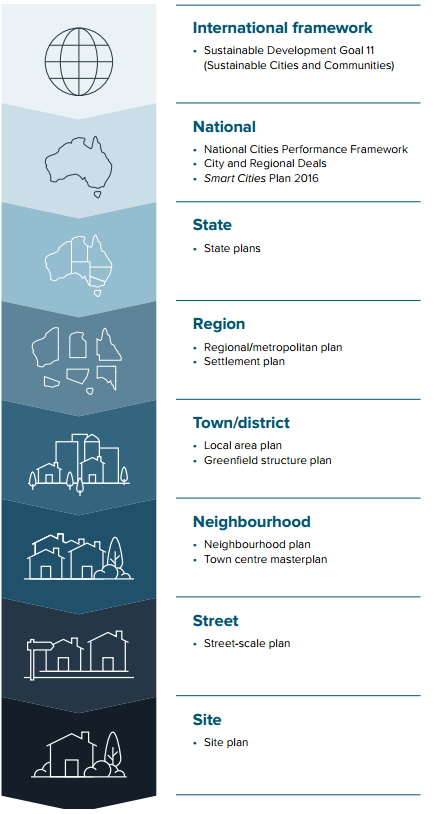
Source: Adapted from the Australian Sustainable Built Environment Council (2015)9