A networked view of infrastructure to deliver sustainable growth
In cities, users typically have access to high-quality infrastructure at affordable costs. However, the pace of growth and change in Australia's Fast-growing Cities has put many legacy networks under strain. This is leading to a risk of increasing congestion costs, crowding and diminishing green space in many suburbs.
" The pace of growth and change in Australia's Fast-growing Cities has put many legacy networks under strain. "
While governments are investing heavily in new infrastructure to meet demand, these changes will threaten liveability and productivity if these risks are not adequately addressed.
Service quality in Small Towns, Rural Communities and Remote Areas has often lagged behind cities, with limited access to services and a single or small number of providers for essential needs such as telecommunications and electricity.
Improvements in digital connectivity - notably the National Broadband Network (NBN) rollout -have helped by increasing access to essential services such as health care and education as well as providing greater economic opportunities.
Despite this effort, many areas outside cities still suffer substandard service quality and reliability. Failure to address these service gaps could drive growing inequality and undermine quality of life in some small towns and rural communities.
National competitiveness will be critical to Australia's post-pandemic recovery, but not all regions are equipped to contribute.
Australia has consistently experienced strong growth, particularly in our major cities.15 Some satellite cities adjacent to Fast-growing Cities, such as Geelong, the Gold Coast and the Sunshine Coast have also averaged annual population growth of over 2.3%.16
Concentrated population growth in our cities has attracted Jobs and delivered high levels of economic growth and productivity. But it has also heightened existing pressures on housing, services and the environment.17
As Figure 1.3 demonstrates, significant regional discrepancies exist in infrastructure and service access, with the majority of the most competitive regions clustered in or near the capital cities and coastal areas.
To tackle this challenge, this chapter outlines a reform pathway to making each of the four geographic community types more productive, with higher levels of access to infrastructure and services.
These reforms propose a consistent national approach to assessing infrastructure needs across each community type that reflects their connected and mutually reinforcing nature.
This will create a balanced Australia, where participation, population and productivity are more evenly distributed, leading to a higher overall quality of life and greater economic and environmental resilience.
Figure 1.3: Access to infrastructure and essential services affects national competitiveness
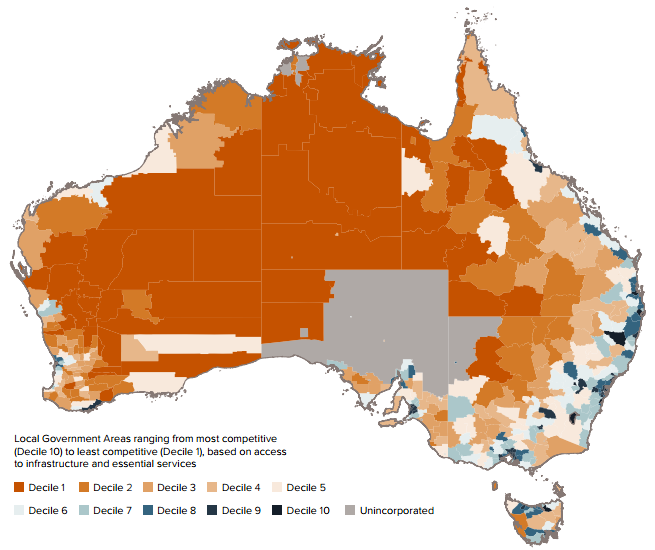
Note: This map is based on ten indicators that cover access to transport, education and health infrastructure. Decile 1 shows the 10% of LGAs with the lowest level of access, while Decile 10 shows the 10% of LGAs with the highest level of access.18
Source: Regional Australia Institute (2021)19