Delivering infrastructure that supports further regionalisation
Australia's Smaller Cities and Regional Centres have unrealised growth potential.
With improved access to employment, education, services, housing and community facilities, many could accommodate further sustainable population and economic growth. This would support a future population settlement pattern that is more widely distributed across the country, benefiting all Australians.
The need for a strategic approach to regionalisation has increased in importance in the past year. Since the impacts of the COVID-19 pandemic in Australia began to be experienced from the March 2020 quarter, indexed net regional migration has increased 66% within a year.54 This includes both people departing capital cities for regional areas, and people already in regions choosing to remain.55 This is being driven by different factors, including relative housing affordability, a preference to 'remain in place' during times of uncertainty and greater flexibility to work remotely, allowing people to make lifestyle-related decisions about where to base themselves.56
Many Smaller Cities and Regional Centres have been trying to attract growth for some time, and are experiencing higher than average levels of historical growth (see Figure 1.5). Emerging trends relating to communities experiencing population growth include locations with a high number of fly-in-fly-out workers, and high-population coastal centres close to capital cities, with the Gold Coast the most popular relocation choice for capital city residents, followed by the Sunshine Coast, Greater Geelong, Wollongong and Newcastle.57
The recent increase in net population growth in regional Australia presents an opportunity to lock in accelerating regionalisation. Currently, regionalisation is uneven, with some communities such as Noosa and Southern Downs in Queensland and Port Macquarie in New South Wales experiencing significant population increases,58 while simultaneously others are experiencing labour shortages.59
Strategic planning is key to ensuring the benefits of larger regional populations do not compromise affordability and amenity.60 A key reason for capital city residents to relocate is the relative housing affordability offered by Smaller Cities and Regional Centres, however population increases have resulted in median house prices in regional Australia increasing at a higher rate than in capital cities, with demand outstripping supply and a scarcity of available dwellings and diverse stock (for example, a shortage of larger homes to accommodate families and working from home arrangements).61 Many of these Smaller Cities and Regional Centres, including Hobart, Greater Adelaide and Canberra, were already classified as unaffordable or moderately unaffordable prior to the pandemic.62
Figure 1.5: Some Smaller Cities and Regional Centres are experiencing faster than usual growth during the COVID-19 pandemic
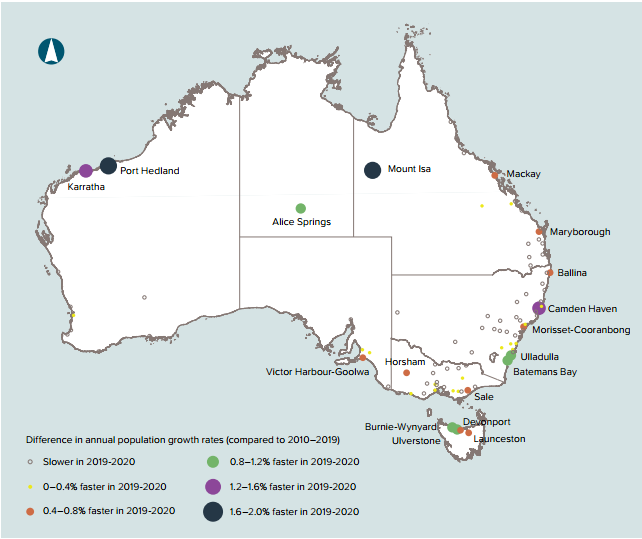
Source: Australian Bureau of Statistics (2021)63
1.2 Recommendation Attract growth to Smaller Cities and Regional Centres while maintaining quality of life by enhancing local identity, leveraging social infrastructure and improving digital and economic connectivity to Fast-growing Cities and neighbouring regions. Proposed sponsor: Department of Infrastructure, Transport, Regional Development and Communications Supported by: Department of Industry, Science, Energy and Resources | ||||
When this should impact: |
| Where this should impact: |
| |
| 1.2.1 Identify infrastructure needs by developing a regional strengths and gaps infrastructure prioritisation framework, supported by a classification of the geography of regional Australia. Proposed lead: Infrastructure Australia Supported by: State and territory infrastructure departments, Regional development bodies | |||
| Build the infrastructure pipeline by identifying and prioritising regional infrastructure gaps, based on existing regional development strategies across government, and industry and community consultation. Proposed lead: Infrastructure Australia Supported by: State and territory infrastructure departments, Regional development bodies | |||
| Inform investment priorities by undertaking regional infrastructure needs assessments on a rolling basis. Proposed lead: State and territory infrastructure departments Supported by: Regional development bodies | |||
| Attract and retain residents and businesses by identifying and sequencing appropriate infrastructure requirements according to local community characteristics. Proposed lead: State and territory planning departments Supported by: State and territory infrastructure departments, Regional development bodies | |||
| 1.2.2 Benchmark performance of Smaller Cities and Regional Centres by defining a consistent set of urban data for provision by state, territory and local governments as a condition for funding projects identified by the needs assessment. Proposed lead: Department of Infrastructure, Transport, Regional Development and Communications Supported by: Bureau of Infrastructure and Transport Research Economics | |||
| Inform urban policy by publishing the data within the National Cities Performance Framework and Progress in Australia's Regions dashboard. Proposed lead: Department of Infrastructure, Transport, Regional Development and Communications | |||
| Monitor performance through bi-annual reporting on trends. Proposed lead: Department of Infrastructure, Transport, Regional Development and Communications | |||
| 1.2.3 Support employment and population growth in Smaller Cities and Regional Centres by identifying and delivering enabling infrastructure. Proposed lead: Department of Infrastructure, Transport, Regional Development and Communications Supported by: Bureau of Infrastructure and Transport Research Economics, state and territory infrastructure departments, state and territory transport departments | |||
| Inform business case development for major projects by analysing data about settlement patterns (including Aboriginal and Torres Strait Islander settlement patterns), employment availability and variety, business locations and housing and infrastructure access. Proposed lead: State and territory planning departments | |||
| Identify transport options by reviewing current and future movement between Smaller Cities and Regional Centres and Fast-growing Cities. Proposed lead: Bureau of Infrastructure and Transport Research Economics Supported by: State and territory transport departments and Department of Infrastructure, Transport, Regional Development and Communications | |||
| Support efficient planning and delivery by taking a staged approach to connectivity, identifying enabling infrastructure projects and accessibility improvements, basing decisions on current and forecast movement and embedding changes in land use and planning decision-making. Proposed lead: Department of Infrastructure, Transport, Regional Development and Communications Supported by: National Faster Rail Agency | |||
| Facilitate more Australians living within three hours of an aviation gateway connected to a Fast-growing City by using movement data to prioritise investment in regional airport infrastructure. Proposed lead: Department of Infrastructure, Transport, Regional Development and Communications | |||
| Support pandemic recovery by developing industry strategies for sectors that will deliver employment opportunities and growth. Proposed lead: State and territory industry departments | |||
| Support growth and incumbent industries in each region by establishing a framework to sequence infrastructure investment based on industry-specific, place-based infrastructure needs assessments. Proposed lead: Infrastructure Australia Supported by: Department of Industry, Science, Energy and Resources | |||
| 1.2.4 Ensure existing and planned digital infrastructure will meet the changing requirements of users in Smaller Cities and Regional Centres by reviewing infrastructure rollout plans. Proposed lead: Department of Infrastructure, Transport, Regional Development and Communications Supported by: NBN Co | |||
| Address capacity constraints in high-growth Smaller Cities and Regional Centres by targeting investment at established data-intensive industries. Proposed lead: Department of Infrastructure, Transport, Regional Development and Communications Supported by: NBN Co | |||
| Support greater wholesale and retail competition by facilitating greater sharing of physical infrastructure and infrastructure corridors servicing regional centres. Proposed lead: Department of Infrastructure, Transport, Regional Development and Communications Supported by: NBN Co, state and territory transport departments, state and territory planning departments | |||




Measuring progress
| Regional Infrastructure plans Regional Infrastructure plans for Smaller Cities and Regional Centres | ||
Governance | Target: 95 plans | Timeframe: |
|
| Regional Centre jobs growth Jobs growth in Smaller Cities and Regional Centres | ||
Economic | Target: Equal to national average | Timeframe: |
|
| Regional Centre GDP growth Average GDP growth in Smaller Cities and Regional Centres | ||
Economic | Target: Equal to Fast-growing Cities average | Timeframe: |
|