An economic powerhouse with great potential
This reform incorporates Northern Australia, which covers the Northern Territory and the northern parts of Queensland and Western Australia (see Figure 1.9), and developing regions with limited established infrastructure yet strong growth prospects where industry composition is changing.
Northern Australia encompasses 53% of Australia's land mass but is home to only 5.2% of the population (1.3 million people).104 Settlements are widely spread and range from coastal cities with populations of more than 100,000 to dispersed remote communities of 100 people.
Figure 1.9: The geographic position of Northern Australia is key to its potential contribution
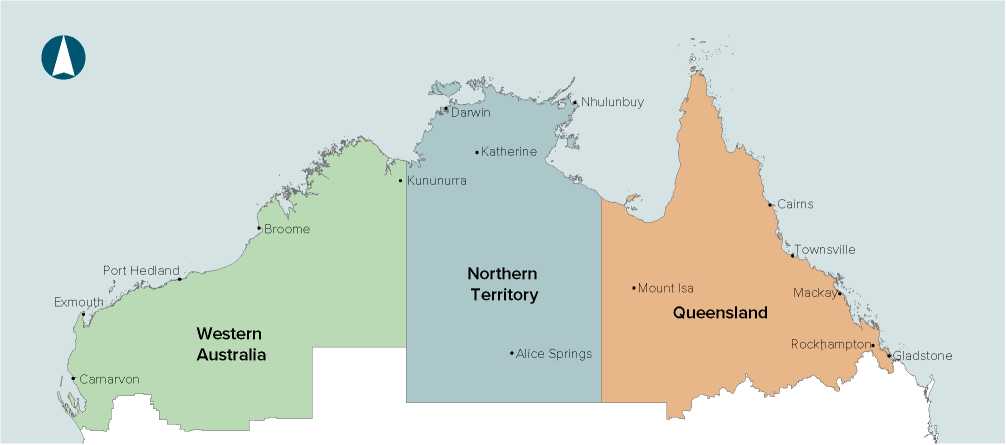
Note: These boundaries are as per the definition of Northern Australia in the Northern Australia Infrastructure Facility Act 2016 (Cth).
The area is already a major contributor to the Australian economy. It generates about 8% of Australia's GDP and its per capita Gross Regional Product is 50% higher than for Australia as a whole.105
It is the major energy production hub for Australia and the largest producer of this country's three leading exports - metallic minerals, coal and liquefied natural gas (LNG).106 In 2019-20, agricultural production in Northern Australia was over $9 billion - 15% of Australia's total.107
With strategic infrastructure investment, the region has the natural resources and geographic position to make an even larger contribution to the Australian economy.
This would enable it to realise potential across current and emerging industry sectors, attract and retain skilled workers and deliver sustainable benefits to its communities.