Building resilient communities through systemic, collaborative planning
The 2079 Audit found trends impacting infrastructure planning were creating growing uncertainty.
Since then, bushfires, drought, storms, floods, coastal erosion, cyberattacks and the COVID-19 pandemic have highlighted the interconnected nature of Australia's infrastructure, environment, people and places. They have also shown the importance of building infrastructure resilience to safeguard communities, ecosystems and the economy.
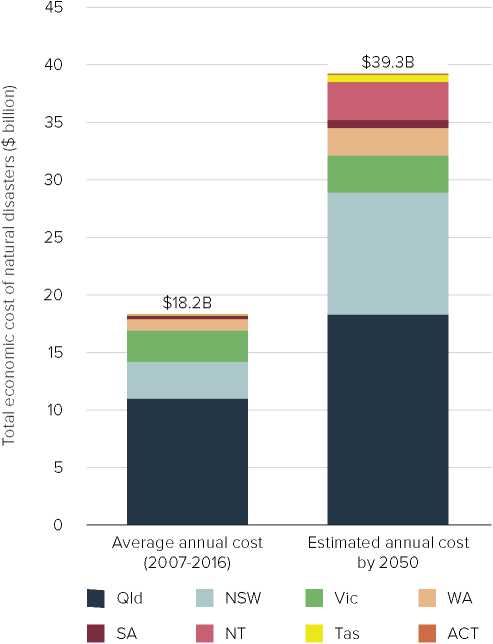
While Australia has experienced profound disruption before, the scale, pace and interconnected nature of change is unprecedented today and predicted to grow.26 As Figure 2.2 shows, the related economic costs will increase accordingly.
Figure 2.2: The economic cost of disasters will more than double by 2050
Source: Australian Business Roundtable (2017)27
As uncertainty increases and systems become more complex and interdependent, infrastructure assets and networks are becoming more vulnerable. In response, a systemic consideration of resilience has emerged as an approach that focuses on the capacity of a system to maintain or recover functionality in the event of disruption or disturbance. It considers the contribution the asset makes to the resilience of the whole system rather than the resilience of the individual asset.
The first step in a systems approach to resilience is to develop a consistent, nationwide understanding of the risks Australia faces, including:
• community needs and preferences
• the value of resilience
• the ways infrastructure assets interact
• the systems they influence
• the roles and responsibilities for managing risks.
The singular, siloed perspective that is common today will largely have to shift to a collaborative approach that strengthens the resilience of assets and networks, systems, places and communities across Australia. This will demand coordination and collaboration across multiple government levels and sectors. No single sector or organisation can do this work alone.
Taking a systemic approach also means sharing responsibility and accountability across all participating organisations. To build a model of shared responsibility, infrastructure owners and operators must work with land use planners, emergency services, businesses, academics, technical experts and communities within, and across, state borders.
The model must align collaborative action with organisational responsibilities. In particular, it should set out clear responsibilities for governance and for coordinating place-based network and asset planning and decision-making.
An all-hazards approach will also be required.
This assumes the functions and activities used to manage one event are likely to apply to a range of events, whether they are caused by natural or human activity. Event types include natural disasters, acts of terrorism, financial market crashes, failure of critical infrastructure (power, water and digital) and ecosystem collapse.
Collecting and analysing critical disaster and climate data, along with information on the exposure of people and assets, will help to develop a clear understanding of the full costs borne by communities when disasters strike. This will help to value resilience consistently though the infrastructure lifecycle. By quantifying the risks, costs, benefits and performance of resilient assets and consistently valuing resilience, there will be a stronger economic case for effective investment and more informed decision-making.
| 2.1 Recommendation Build community resilience to all hazards by considering systemic risks, interdependencies and vulnerabilities in infrastructure planning and decision-making. Proposed sponsor: National Recovery and Resilience Agency Supported by: Department of Home Affairs, state and territory resilience agencies, state and territory planning departments, state and territory infrastructure departments, local governments, state and territory emergency management agencies, state and territory environment departments and asset owners and operators | ||||
| When this should impact: |
| Where this should impact: |
| |
|
| 2.1.1 Create an environment for consistent action by establishing clear cross-sector policy priorities to inform resilience planning, policy prioritisation and reform decisions. Proposed lead: National Recovery and Resilience Agency | |||
|
| Improve strategic oversight and coordination of resilience outcomes across sectors and Jurisdictions by establishing nationally consistent scenarios and common policy priorities. Proposed lead: National Recovery and Resilience Agency Supported by: Department of Prime Minister and Cabinet, Australian Treasury, Department of Home Affairs, Department of Agriculture, Water and the Environment, state and territory resilience agencies, state and territory planning departments, state and territory infrastructure departments, local governments, state and territory emergency management agencies and state and territory environment departments | |||
|
| 2.1.2 Improve community resilience and coordinated action through a consistent, nationwide, systemic approach to risk identification. Proposed lead: National Recovery and Resilience Agency Supported by: Department of Home Affairs and Australian Climate Service | |||
|
| Facilitate collaboration across sectors, layers of government, asset owners and operators, businesses and communities by creating formal governance arrangements, resourcing and a convening authority in line with the National Disaster Risk Reduction Framework. Proposed lead: National Recovery and Resilience Agency Supported by: Department of Home Affairs, state and territory resilience agencies, state and territory planning departments, state and territory infrastructure departments, local governments, state and territory emergency management agencies, regional development bodies and state and territory environment departments | |||
|
| Enable timely information exchange and build accountability by expanding participants to the Trusted Information Sharing Network, sharing information and best practice and developing connections and ongoing relationships. Proposed lead: Department of Home Affairs Supported by: National Recovery and Resilience Agency, asset owners and operators, industry representative groups, state and territory planning departments, state and territory infrastructure departments, local governments, state and territory emergency management agencies and state and territory environment departments | |||
|
| Inform decisions on risk reduction options and approaches, and enable data driven decision-making by standardising and sharing data about disasters, hazards and asset and network interdependency. Proposed lead: National Recovery and Resilience Agency Supported by: Department of Home Affairs, Australian Climate Service, state and territory planning departments, state and territory infrastructure departments, local governments, state and territory emergency management agencies and state and territory environment departments | |||
|
| Improve place-based and network-based systemic risk assessment and decision-making by producing local hazard maps for asset owners and operators and communities. Proposed lead: National Recovery and Resilience Agency Supported by: Department of Home Affairs, Australian Climate Service, Department of Agriculture, Water and the Environment, state and territory planning departments, state and territory infrastructure departments, local governments, state and territory emergency management agencies, state and territory environment departments and asset owners and operators | |||
|
| Inform decisions to increase the resilience of a place, network or asset across Australia by identifying cascading systemic failures, interdependencies and interconnections and local vulnerability of all sectors' assets and networks. Proposed lead: National Recovery and Resilience Agency Supported by: Department of Home Affairs, Australian Climate Service, Department of Agriculture, Water and the Environment, local governments, state and territory departments of local government, asset owners and operators, and communities | |||
|
| Better predict and mitigate major hazards and risks with a national risk and disaster probability model for all hazards. Proposed lead: National Recovery and Resilience Agency Supported by: Department of Home Affairs, Australian Climate Service, state and territory planning departments, state and territory infrastructure departments, local governments, state and territory emergency management agencies and state and territory environment departments | |||
|
| Ensure a systemic approach to resilience is established and considered by place-based resilience bodies, such as Resilience Sydney. Proposed lead: Local governments Supported by: State and territory departments of local government and National Recovery and Resilience Agency | |||
|
| 2.1.3 Facilitate joint action by establishing a common, long-term understanding of the potential impacts of climate change, both nationally and locally, that informs land use and infrastructure planning and decision-making. Proposed lead: Department of Agriculture, Water and the Environment Supported by: Australian Climate Service, National Recovery and Resilience Agency and state and territory environment departments | |||
|
| Enable consistent planning, shared responsibility and joint action by establishing long-term (2035, 2050 and 2100) Australian national climate scenarios. These should be based on possible climate futures that align with different Representative Concentration Pathways, and projections and forecasts for economic activity, energy use and land use patterns. Proposed lead: Department of Agriculture, Water and the Environment Supported by: CSIRO: Commonwealth Scientific and Industrial Research Organisation, Bureau of Meteorology and Australian Climate Service | |||
|
| Establish a national understanding of climate adaptation risk assessment by publishing and communicating the scenarios. Target communities with differing levels of scientific and technical expertise, from technical roles to decision-makers and the broad community. Ensure the tools and data are accessible and increase understanding. Proposed lead: Department of Agriculture, Water and the Environment Supported by: CSIRO: Commonwealth Scientific and Industrial Research Organisation, Bureau of Meteorology and Australian Climate Service | |||
|
| Support cross-sector coordination and shared responsibility by undertaking and publishing an annual assessment of the consideration and effectiveness of climate risk and resilience in infrastructure planning and decision-making. Proposed lead: Infrastructure Australia Supported by: State and territory infrastructure bodies and industry representative groups | |||
|
| Embed climate risk considerations into land use and infrastructure planning and decision-making by developing a training program, tools and guidance materials. Proposed lead: Infrastructure Australia Supported by: National Recovery and Resilience Agency, state and territory planning departments, state and territory infrastructure departments, local governments, state and territory emergency management agencies, state and territory environment departments, state and territory infrastructure bodies and asset owners and operators | |||
|
| Ensure existing and future asset planning considers climate risk by conducting climate adaptation risk assessments, developing strategic planning and policy decisions, and designing and approving future assets using climate scenarios, tools and guidance. Proposed lead: Infrastructure Australia Supported by: National Recovery and Resilience Agency, state and territory infrastructure bodies, industry representative groups, asset owners and operators, infrastructure investment assurance and assessment agencies and state and territory treasuries | |||
|
| Ensure climate risk is incorporated into infrastructure projects and services by mandating the consideration of climate risk in project assessment. Proposed lead: Infrastructure investment assurance and assessment agencies Supported by: State and territory treasuries, state and territory infrastructure bodies and industry representative groups | |||
|
| 2.1.4 Ensure infrastructure decisions consider resilience through clear and harmonised guidance on how projects can address risks and value resilience. Proposed lead: State and territory infrastructure bodies Supported by: Infrastructure investment assurance and assessment agencies, state and territory treasuries, industry representative groups, Coalition for Climate Resilient Investment and National Recovery and Resilience Agency | |||
|
| Ensure infrastructure assessment frameworks, and associated tools and guidance, including the Australian Transport Assessment and Planning Guidelines, consider risks and resilience by incorporating future scenarios and hazard information. Proposed lead: Department of Infrastructure, Transport, Regional Development and Communications Supported by: Infrastructure Australia, state and territory infrastructure bodies, infrastructure investment assurance and assessment agencies, state and territory treasuries and ATAP Steering Committee Secretariat | |||
|
| Support land use and strategic planners, infrastructure and emergency planners and local governments to develop state and territory, regional and local plans by enhancing infrastructure assessment frameworks and associated climate and disaster risk tools and guidance. Proposed lead: State and territory planning departments Supported by: Australian Climate Service, National Recovery and Resilience Agency, Infrastructure Australia and state and territory infrastructure bodies | |||
|
| Value resilience in infrastructure investment by developing a training program and guidance materials on how to value resilience in decision-making through the infrastructure lifecycle. Proposed lead: Infrastructure Australia Supported by: State and territory infrastructure bodies, industry representative groups and Coalition for Climate Resilient Investment | |||




Measuring progress
|
| Natural disaster impact on people Number of directly affected persons attributed to disasters (UN Sustainable Development Goal 13.11)28 | ||
| Social | Target: 17.8 (per 100,000 population, 3-year average) | Timeframe: |
|
|
| Consideration of climate risk Percentage of proponents applying climate guidance and tools under Infrastructure Australia Assessment Framework | ||
| Governance | Target: 100% | Timeframe: |
|
|
| Average annual cost of disasters Stabilise the cost of disaster in real terms at 2019 levels29 | ||
| Economic | Target: (2019) $18.2Bn | Timeframe: |
|