Focusing more on the 'bits and bytes'
Australia's infrastructure sector has grown substantially over recent decades. Today, the broader industry accounts for nearly 20% of Australia's GDP and directly employs 1.2 million people.87
However, the sector's productivity has lagged behind the growth and productivity of other Australian sectors.88 To address this poor productivity trend, there is a clear opportunity for government to make digital innovation the core of all infrastructure decision-making.89
While there has been some progress in adopting digital tools and approaches, it is ad-hoc. Given the scale of the sector, and the magnitude of current and future investment, efforts to embrace digital innovation will unlock substantial productivity gains for the wider community (see Figure 3.4).
Implementing best technology practices could result in a productivity improvement up to 15% and more than 5% in cost efficiencies.90 If proven digital tools and practices are used now, the sector can realise benefits rapidly.
However, their use requires governments to challenge the current approach to procurement, engagement, and information handover. It will include a progression away from analogue approaches towards the adoption of digital tools and practices as the default for infrastructure projects.
Building Information Modelling (BIM)and digital engineering are two examples of suitably well-established digital tools and approaches. They have been shown to deliver better project outcomes, increase productivity and improve infrastructure performance.91
Figure 3.4: Embracing digital and data opportunities will unlock productivity and drive value
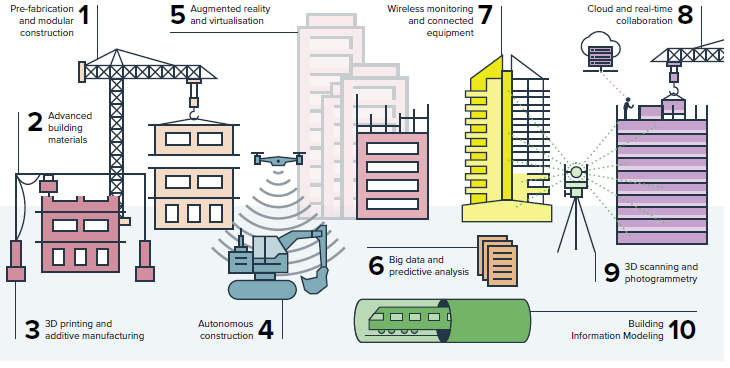
Source: Adapted from Future of Construction (2018)92