Realise the value of data to start the innovation revolution
When it comes to infrastructure, the term 'innovation' is often associated with approaches that are new, untested or different. However, in many circumstances, innovation should involve thinking more about practices, tools and information that are already available and how they could be more effective and efficient if adapted or reused.
This approach requires governments to embrace data and information capture, structure, sharing and reuse across infrastructure delivery and operations.99 This requires a more mature approach in valuing data that is created, procured and (often) disposed of.100
Other countries are leading the way. For example, Transport for London now shares much of its data publicly, which contributes an estimated £130 million per year to the local economy.101
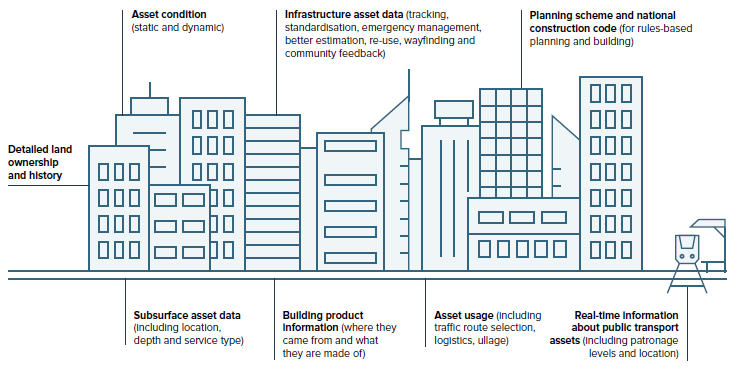
In Australia, New South Wales has introduced Transport for NSW's Transport Connected Bus Program and a real-time open data program that feeds into customer information apps and other tools. As these examples show, improving how data is captured, used and shared can unlock diverse economic, governance, social and environmental benefits (see Figure 3.5).
Unlocking these benefits is contingent on working across traditional government silos. Cross-departmental agencies, such as Digital Twin Victoria, show it is possible to address this challenge. 102
State and territory digital twin owners should be tasked with identifying, collecting, collating or providing data from the infrastructure sector for third party use.
Some areas where there could be greater uptake are:
• e-planning
• modernising cadastral systems (land information such as boundaries and subdivision size)
• creating and sharing digital twins
• maintaining accurate and valuable spatial information
• federating data from public and private works
• creating and maintaining relevant standards
• incorporating open data collection and provision as a standard requirement in tenders
• establishing more seamless cross-stakeholder data-sharing, storage and access arrangements.
" Improving how data is captured, used and shared can unlock diverse economic, governance, social and environmental benefits. "
For more information about the value of creating digital twins, see the next section.

Figure 3.5: Infrastructure datasets can unlock economic, social and environmental benefits