Decisions should support a national vision
To guide investment in transport infrastructure over multiple generations, all planning, funding and delivery agencies need to share a single vision for Australia.7
By understanding and working towards this vision, they will make decisions that produce the desired outcomes for population, settlement and land use.
To support the vision, the Australian Government should align transport funding with Jurisdictions' intended land use outcomes. For instance, the Gold Coast Light Rail project has been designed to integrate sensitively with vibrant urban places while providing the capacity to handle significant and growing movement flows (see Figure 4.1).
" All planning, funding and delivery agencies need to share a single vision for Australia. "
Figure 4.1: Gold Coast Light Rail integrates with the Gold Coast University Hospital campus
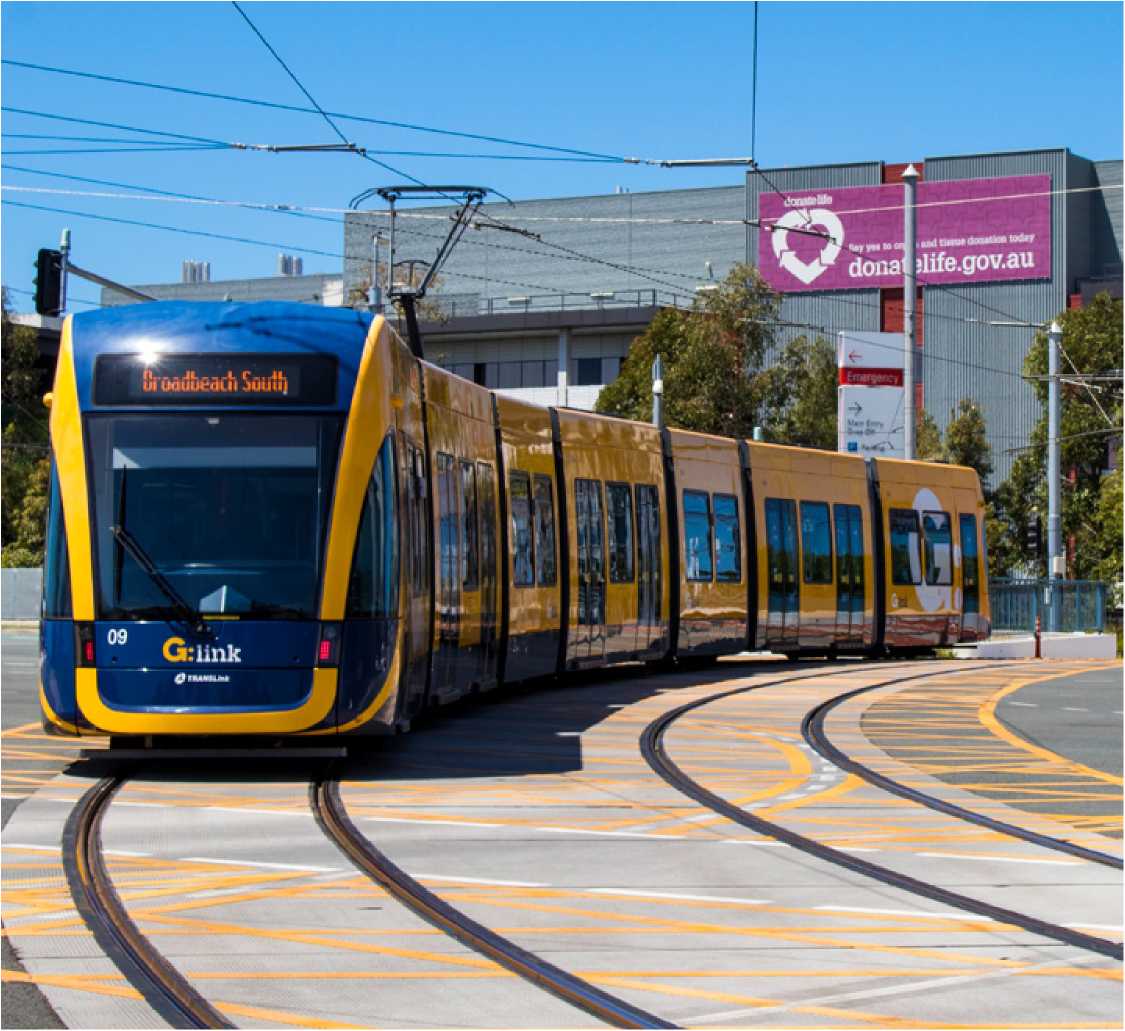
Image source: Translink, Queensland Department of Transport and Main Roads (2021)8
The Australian Government should also require nationally significant transport infrastructure proposals to refer to these outcomes when they are planned and executed.
If a nationally consistent set of modelling tools and assumptions is applied when forecasting land use and transport outcomes, funding will more equitable.
When there are alternative proposals for transport investment, using consistent inputs will also help to assess them.
It will identify proposals that are incompatible or that might not perform well against goals such as attracting more business investment in an area or lifting local development.
In this situation, governments must defer investment in the proposals that offer poorer performance.
For more information on consistent approaches to project planning across all infrastructure sectors refer to the Industry productivity and innovation chapter.
See the Place-based outcomes for communities chapter for more information on infrastructure investments that connect our cities, towns and regions.