Improve connectivity for regional, rural and remote areas
Smaller Cities and Regional Centres as well as Small Towns, Rural Communities and Remote Areas offer many quality-of-life and economic growth opportunities.
For these places to realise their potential, governments must strengthen supply chains and ensure passenger transport services provide reliable access to jobs and services.
Supply chain Each link in a supply chain is an action required to get a product or service to its end user. Links move and transform raw materials into finished products, transport them to distribution points, and deliver them to customers. |
The reforms proposed in the 2021 Plan address end-to-end Journey outcomes for moving people and freight around regional and remote areas.
The actions Infrastructure Australia proposes will:
• reinforce the supply chains that connect regional and remote Australia to Fast-growing Cities and export gateways
• deliver staged passenger rail improvements that support the growth of Smaller Cities and Regional Centres
• set user-focused performance standards to guide both infrastructure investment and operational coordination across all the passenger transport modes that service Small Towns, Rural Communities and Remote Areas.
4.2 Recommendation Improve the liveability and economic sustainability of regional, rural and remote areas by developing, maintaining and operating integrated freight and passenger transport networks that meet end-to-end access needs. Proposed sponsor: Department of Infrastructure, Transport, Regional Development and Communications Supported by: State and territory transport departments, local governments | |||
When this should impact: |
| Where this should impact: |
|


| 4.2.1 Maintain reliable access for supply chains under all conditions by coordinating technological, operational and infrastructure improvements delivered under the National Freight and Supply Chain Strategy. Proposed lead: Department of Infrastructure, Transport, Regional Development and Communications Supported by: Department of Industry, Science, Energy and Resources, CSIRO: Commonwealth Scientific and Industrial Research Organisation, National Transport Commission, state and territory transport departments, local governments, airport operators, port operators |
| Identify supply chain improvement opportunities across multiple commodities and geographies by developing and applying the TraNSIT model. Drive more responsive supply chain management decision-making by making this evidence accessible to governments, industry and other stakeholders through the National Freight Data Hub. Proposed lead: Department of Infrastructure, Transport, Regional Development and Communications Supported by: CSIRO: Commonwealth Scientific and Industrial Research Organisation, National Transport Commission |
| Deliver local safety, environmental and economic benefits for regional, rural and remote communities by identifying and prioritising freight intermodal projects that promote shifting from road to Inland Rail and other freight rail services for targeted commodities. Proposed lead: Department of Infrastructure, Transport, Regional Development and Communications Supported by: State and territory transport departments, local governments |
| Develop and implement place-based action plans for Fast-growing City port and airport precincts, through government, industry and community partnerships, that align with the National Urban Freight Planning Principles. Improve the efficiency of export- and tourism-oriented corridors by implementing actions that reduce friction between freight operations and dense land uses. Proposed lead: Department of Infrastructure, Transport, Regional Development and Communications Supported by: State and territory transport departments, local governments, airport operators, port operators |
| Enable remote area supply chain cost savings by increasing domestic freight operators' access to alternative fuels, including hydrogen produced under initiatives that are currently oriented towards overseas customers and/or non-transport heavy industrial uses such as mining. Proposed lead: Department of Infrastructure, Transport, Regional Development and Communications Supported by: Department of Industry, Science, Energy and Resources |
| 4.2.2 Support the growth and diversification of Smaller Cities and Regional Centres by investing in their local accessibility and connectivity and progressively upgrading transport connections to Fast-growing Cities. Proposed lead: Department of Infrastructure, Transport, Regional Development and Communications Supported by: National Faster Rail Agency, Australian Treasury, state and territory transport departments, local governments |
| Improve connectivity in and around Smaller Cities and Regional Centres by investing in multimodal transport interchanges integrated with mixed land uses that are adjacent to the train station or (for locations without a train service) the central business district. Proposed lead: State and territory transport departments Supported by: Local governments |
| Improve public transport access to the heart of Smaller Cities and Regional Centres from their suburban and rural catchments by supporting the operation of flexible and demand-responsive services. Proposed lead: State and territory transport departments Supported by: Local governments |
| Promote active travel for tourism, recreation and local access in and around Smaller Cities, Regional Centres, Small Towns, Rural Communities and Remote Areas by investing in the adaptive reuse of disused railways and integrating these with other linear open space corridors and low-traffic rural roads to provide connected networks. Proposed lead: State and territory transport departments Supported by: Local governments |
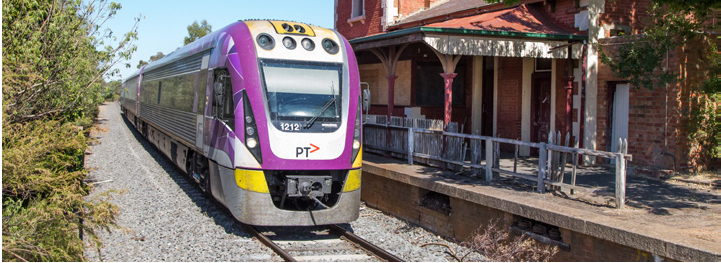
| Strengthen the connection of Smaller Cities and Regional Centres to Fast-growing Cities by progressively upgrading existing regional passenger rail services. Make services more comfortable and reliable, and grow the patronage base for public transport, by investing in customer experience improvements such as new rolling stock and in track projects that maximise the separation of freight and passenger movements. Proposed lead: Department of Infrastructure, Transport, Regional Development and Communications Supported by: National Faster Rail Agency, state and territory transport departments |
| To improve the connectivity and economic performance of outer-urban areas, ensure regional rail service improvements improve accessibility outwards from Fast-growing Cities, and better connect outer-urban areas to their larger regional catchment as well as making established central business districts more accessible to Regional Centres. Proposed lead: State and territory transport departments Supported by: National Faster Rail Agency, local governments |
| Support regional growth by prioritising faster rail, fast rail and high-speed rail investments based on credible scenarios for population change and using nationally consistent decision-making processes. These should include models and assumptions that are updated to evaluate project benefits and costs across wide geographic areas and over the full life of rail assets. Proposed lead: Department of Infrastructure, Transport, Regional Development and Communications Supported by: Australian Treasury, National Faster Rail Agency |
| Maximise economic, productivity and safety benefits from governments' fast rail, faster rail and high-speed rail investments. Invest in the timely preservation of surface corridors. Ensure the cross-border interoperability of projects is advanced in different locations. Proposed lead: Department of Infrastructure, Transport, Regional Development and Communications Supported by: National Faster Rail Agency, state and territory transport departments |
| 4.2.3 Ensure equitable access to essential services for Small Towns, Rural Communities and Remote Areas by coordinating passenger transport investments and operations. Proposed lead: Department of Infrastructure, Transport, Regional Development and Communications Supported by: State and territory transport departments, airport operators |
| Develop and adopt nationally consistent performance standards for Small Towns, Rural Communities and Remote Areas to physically access essential services that cannot be effectively provided online. Articulate standards in terms of the total time taken by people in a rural or remote area to travel to and access the education, health or other services offered by a Smaller City or Regional Centre, and then return home. Proposed lead: Department of Infrastructure, Transport, Regional Development and Communications |
| Align spending and service delivery across transport modes with performance standards for Small Town, Rural Community and Remote Area access. Enable the greatest possible proportion of the population of these communities to access centre-based services cost-effectively within a day-return or other reasonable specified timeframe. Proposed lead: Department of Infrastructure, Transport, Regional Development and Communications Supported by: State and territory transport departments |
| Ensure long-distance passenger travel needs are serviced cost-effectively and in line with access performance standards. Do this by integrating regional aviation infrastructure and services programs with land transport services under a multimodal hub-and-spoke network model. Proposed lead: Department of Infrastructure, Transport, Regional Development and Communications Supported by: State and territory transport departments, airport operators |


Measuring progress
| Faster regional connections Smaller Cities and Regional Centres have a planned and staged investment program for Fast-growing City connections | ||
Quality | Target: 100% | Timeframe: |
|
| Regional essential service access One-day return journey for access to essential services | ||
Access | Target: 100% | Timeframe: |
|
| Port and airport place-based plan Major ports and airports have a place-based infrastructure plan and governance framework | ||
Governance | Target: 100% | Timeframe: |
|