Give more people same-day access to essential services
The Australian Government should review the resources it invests in rural and remote area passenger transport services (including domestic aviation) to align with time-based access performance standards.
The investment focus should be on improving people's access to face-to-face services that cannot be delivered online through better digital infrastructure. For information about the need to accelerate a transition to digital delivery, see the Social Infrastructure chapter.
Scheduled point-to-point service A public passenger transport service, with a set timetable, that links a pair of airports, train or coach stations, or bus stops Hub-and-spoke network Coordinates the timetabled operation of different public transport modal services so users can complete journeys by transferring between services at multimodal interchanges |
Where digital services are not possible, access standards are needed to guide priorities for governments' transport infrastructure investment and maintenance programs (including regional airport infrastructure and services) as well as public passenger transport operators.
They should specify the level of access people in Small Towns, Rural Communities and Remote Areas should have to essential services in Smaller Cities and Regional Centres.
For example, someone with same-day access to these services will be confident they can travel from their Remote Area home to a centre using public transport; spend long enough there to attend a specialist medical appointment; then return home using public transport on the same day.
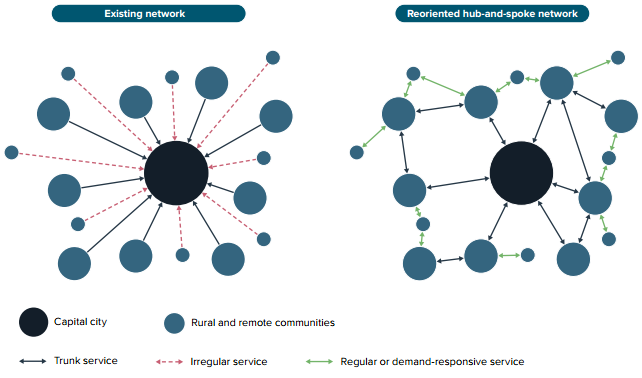
Developing the standards will involve reorienting point-to-point passenger transport services into a hub-and-spoke model (see Figure 4.8).
Under this model, timetables are integrated across modes and operators and flexible and on-demand services are used more.
Demand-responsive or on-demand services Public transport services that operate when and where users need them rather than to a fixed route or timetable. Services may be wholly on-demand, such as taxis or rideshare services provided by drivers using regular cars. Services can also follow a base route or timetable while having the flexibility to respond to local changes in user demand. For example, a demand-responsive minibus service can divert from a core route to pick up or drop off a user at their front door. |
All these reforms will considerably improve the end-to-end journey experience for people in rural and remote areas.29
See the Place-based outcomes for communities chapter for more information on minimum standards for these areas' access to infrastructure services.
For more information on a strategic approach to improving digital access for regional, rural and remote areas, see the Telecommunications and digital chapter.
Figure 4.8: Reoriented passenger transport services provide better end-to-end journeys for rural and remote communities