Normalise door-to-door thinking
Many Australians want active travel to be a safe and realistic choice for more journeys.
During the pandemic, physical distancing rules prompted more people to walk or cycle more often.
Increased active travel during lockdown provided people with physical and mental health benefits.
The Social infrastructure chapter highlights the importance of connected networks of green and blue open space, which can be used for active travel, in giving people access to these benefits into the future.
" Many Australians want active travel to be a safe and realistic choice for more Journeys. "
The Water chapter considers the importance of re-naturalised waterway projects in extending and connecting urban open space and active travel networks.
Looking ahead, nearly one in three people in Australia expect to be cycling or walking more in the future.40 This could involve active travel as the sole mode for a Journey or combined with another mode, such as public transport.
Micromobility Covers a range of one-person (or one adult plus children) travel options that combine aspects of traditional bicycle, scooter or wheelchair use with new power options and/or sharing models. Power-assisted e-bikes and e-scooters are examples of micromobility devices that can be either privately owned or shared. In some locations, they are booked and used through smartphone apps. |
Accelerating the positive impacts of the pandemic on personal mobility will lead to more Australians choosing walking, scootering, skateboarding and biking, as well as micromobility devices such as e-bikes and e-scooters.41
To make these choices a normal part of everyday life, there needs to be:
• lifelong road literacy education that starts in childhood
• lower speed limits wherever urban roads provide strategic links in active travel networks but infrastructure improvements are not yet completed
• simplified, lower-cost active travel infrastructure designs that enable safer, physically separated active travel routes to be completed more quickly (see Figure 4.11)
• the development of gap-free active travel networks that cross local government area boundaries
• updated and nationally adopted road rules that open up Australia to new micromobility technologies.
Figure 4.11: Pop-up cycleways are a model for the timely, tactical rollout of new facilities
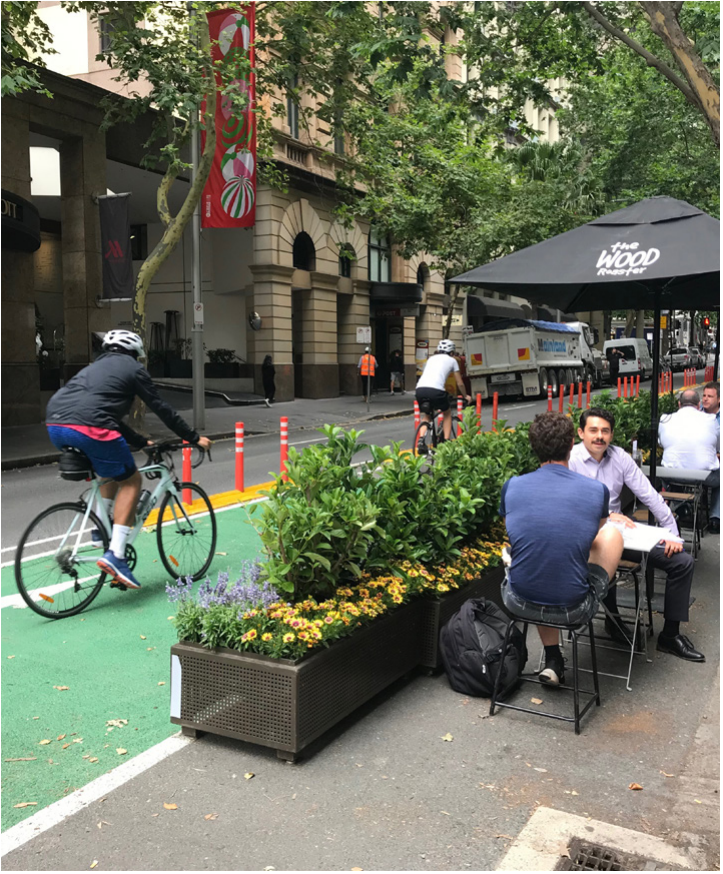
Image source: City of Sydney (2021)
Figure 4.12: Even without financial incentives, Australians want to adopt clean and green motoring
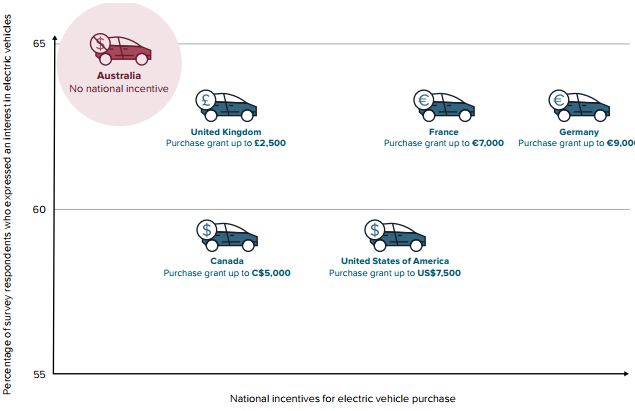
Note: Incentives include electric and plug-in hybrid cars, and do not include state, provincial or other local financial programs, charger installation or old vehicle buy-back initiatives.
Source: Adapted from L.E.K. Consulting (2020)42