Prioritise energy productivity across the economy
Energy efficiency measures are a 'set and forget' investment that pays off through future savings for businesses and households; the increased value of energy-efficient homes and assets; enhanced comfort and liveability; and higher productivity.
They also offer wider community benefits by reducing overall energy demand, which puts downward pressure on wholesale energy prices, and reducing demand peaks, which decreases the need for capital investments in generation and networks that are paid for through customer bills.
The Council of Australian Governments (COAG) Trajectory for Low Energy Buildings (the Trajectory)14 is a national plan that sets a trajectory towards buildings that are zero-energy and zero carbon-ready. Implementing the Trajectory would:
• reduce overall annual energy demand by an estimated 36 terawatt-hours by 2050. This represents a 15% overall reduction in Australia's future electricity consumption and a 74% reduction in peak demand growth15
• reduce network and generation capital expenditure costs by $7.5 billion and $4.1 billion respectively16
• translate into average bill savings of $559 (23%) for residential customers and $13,500 (15%) for business customers by 2050.17
Supporting the realisation of the objectives and broader measures outlined by the Trajectory will be critical to realising these benefits for energy efficiency and productivity across the economy for households and businesses.
" The barriers to greater uptake in Australia are not only financial, but behavioural and informational. "
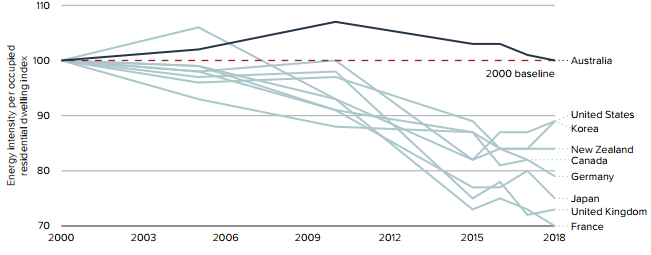
A common proxy indicator for a country's energy efficiency is the energy intensity of its economy (the amount of energy used to generate a unit of economic output).18 Figure 5.2 illustrates Australia's relatively flat energy intensity index (which tracks changes in energy intensity relative to a base year) for residential and business customers from 2000 to 2018. It reflects the low uptake of energy efficiency measures across Australia.
The graph also demonstrates the untapped potential of energy efficiency measures in Australia compared to such countries as New Zealand and those in the United Kingdom, which have greatly improved energy efficiency in the last 20 years.
The barriers to greater uptake in Australia are not only financial, but behavioural and informational.19 Supporting customers to make more informed decisions is therefore essential to unlock all the potential savings from energy efficiency.
Figure 5.2: Australia's residential and manufacturing energy intensities have not improved in recent decades compared to peers
Residential
Manufacturing
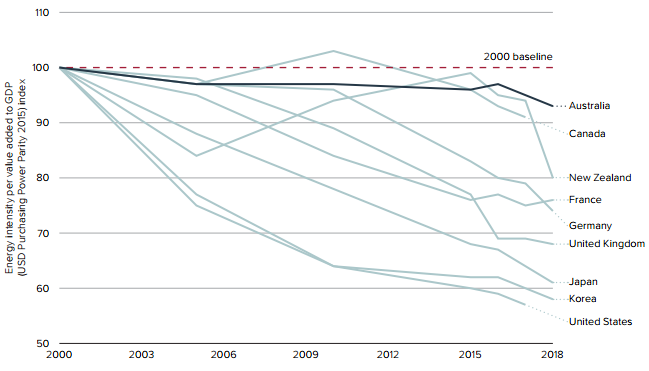
Note: Energy intensity refers to the amount of energy used to generate a unit of economic output. Data available for 2000, 2005, 2010, 2015, 2016, 2017 and 2018.
Source: International Energy Agency (2020)20