Roll out smart meters to enable smarter tools
While other technologies are needed to enable all of the benefits of a smart grid, smart meters are a critical enabler because they give energy users:
• better understanding of the costs associated with their existing electricity consumption patterns
• access to flexible electricity tariffs that have variable prices, depending on time of use
• access to other services, such as energy management and sharing data with third party service providers
• improved ability to integrate, and get the most out of, decentralised energy technologies such as rooftop solar, batteries and electric vehicles.
Smart meters also have wider benefits. They enable electricity distribution network businesses to detect power outages more rapidly and monitor the quality of electricity supply, which will lower the overall cost of operating the power system.36 They can also create data that enables better policy-making and technology development while also protecting customers' privacy.
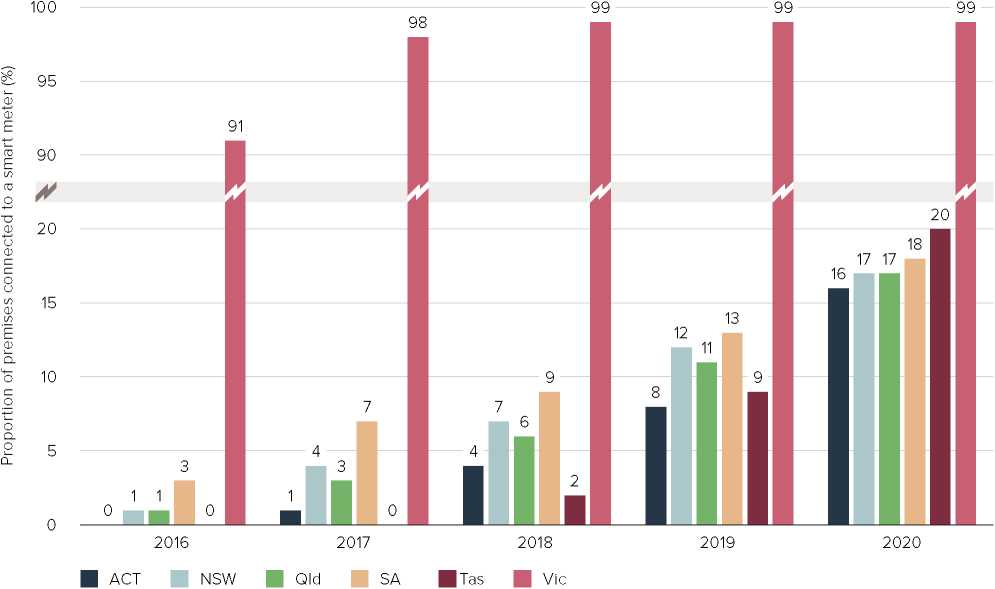
Despite these benefits, Australia has been slow to adopt smart meters. Figure 5.3 shows the pattern of smart meter uptake across the National Electricity Market (NEM) over the past five years. If this trend is projected, it would take at least 20 years for every Australian to get a smart meter. There is a significant opportunity to roll out this enabling technology much more broadly across Australia.
As well as smart meters, governments need to give consumers smart tools and lift energy literacy to help them benefit from participating more actively in the energy market.
To realise the benefits of smart meters, customers need to be able to access their consumption information.37 The Organisation for Economic Co-operation and Development (OECD) found that smart meters accompanied by real-time information are the most successful behavioural intervention for helping consumers reduce their energy consumption.38
In Victoria, the rollout of smart meters has been mandated. Yet the Victorian Auditor-General found that tools to access user-friendly information about electricity use are still not widely taken up, even in Victoria, and highlighted that the lack of a comprehensive communication campaign has reduced the value smart meters have created for customers.39
" As well as smart meters, governments need to give consumers smart tools and lift energy literacy to help them benefit from participating more actively in the energy market. "
Without user-friendly mobile digital tools and a comprehensive communications campaign, smart meters will not create value for customers.
Smart meters can also help consumers share their data with third parties to access new business models and facilitate better planning.
As well as making switching services easier, the Consumer Data Right for Energy40 being driven by the Australian Treasury will help preserve privacy and give consumers the ability to safely share data with third parties, so they can participate in the market through mechanisms such as virtual power plants that coordinate decentralised assets.
Figure 5.3: A large proportion of customers are not taking advantage of smart meters, except in Victoria where there was a mandatory rollout
Note: Figures are based on AEMO retail transfer statistical data (MSATS).
Source: Australian Energy Market Commission (2020)41