Clean energy is here to stay
The energy transition is moving fastest in generation. Fossil fuels are rapidly being replaced by renewables. Figure 5.4 shows that retiring coal generation capacity is being replaced by renewable solar and wind generation, and this trend will only accelerate.
Furthermore, coal power station closures are being brought forward. For example, Victoria's Yallourn coal power plant will close in 2028 rather than in 2032 as previously planned.55
Figure 5.4: Generation is increasingly shifting from fossil fuels to renewables
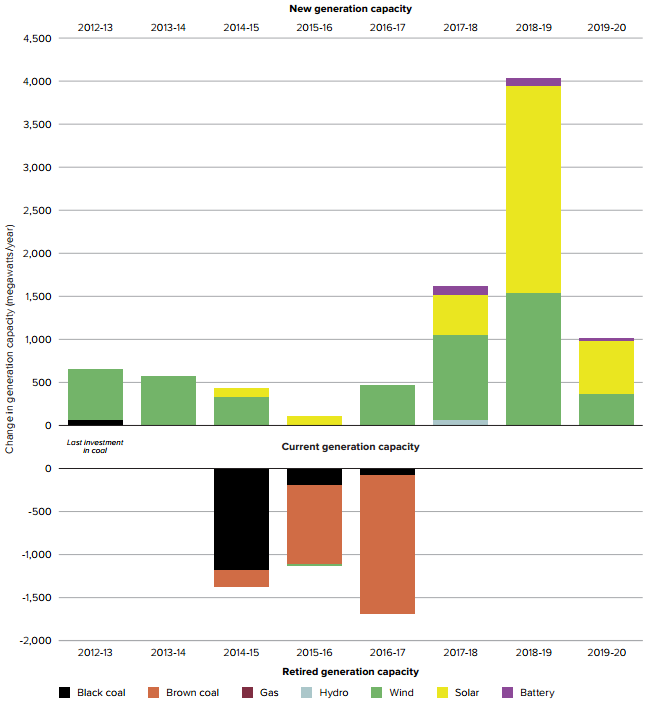
Note: Battery storage is treated as generation in the National Electricity Rules. Capacity includes scheduled and semi-scheduled generation, but not non-scheduled or rooftop PV capacity. Data for 2019-20 does not include April, May or June 2020.
Source: Australian Energy Regulator (2020)56
Australia is well placed to transition its electricity generation mix to renewable energy. It has some of the world's richest clean energy resources, particularly solar and wind. These abundant renewable energy resources can support both affordable and reliable energy here and clean energy export industries such as hydrogen production and energy-intensive manufacturing.
However, currently Australia is heavily reliant on coal and gas for domestic use and export.
Australia is a global superpower energy exporter of coal and gas, exporting more than two-thirds of Australian energy production.57. In 2019, renewable energy sources accounted for 24% of Australia's total electricity generation,58 but this percentage is rising rapidly as the falling cost of renewables drives a transformative change in the energy generation mix.
All levels of government should be working together to help to shape a low-emission future that benefits all Australians.
In particular, there needs to be strong national leadership and planning to coordinate efforts. This transition is critical to meeting the Australian Government's focus on affordable and reliable energy, as noted by Prime Minister Scott Morrison: 'as we transition to a low-emission economy and we move towards net zero as soon as possible, and preferably by 2050'.59
" All levels of government should be working together to help to shape a low-emission future that benefits all Australians, both now and in the future. "
The final reform in this chapter builds on work already being undertaken by the Australian Government, as outlined in Australia's Technology Investment Roadmap, First Low Emissions Technology Statement - 202060 and Australia's National Hydrogen Strategy.61
5.3 Recommendation Transition Australia's exports and domestic energy demand to high-tech, low-cost, low-emission energy sources through a coordinating national strategy. Proposed sponsor: Department of Industry, Science, Energy and Resources | |||
When this should impact: |
| Where this should impact: |
|


| 5.3.1. Ensure Australia remains an energy export supplier of choice in decarbonised global supply chains by coordinating national development of low-emission energy sources. Proposed lead: Department of Industry, Science, Energy and Resources Supported by: State and territory energy departments |
| Enable collaboration opportunities, shared infrastructure and regulatory consistency across jurisdictions by coordinating a national approach to energy planning. Proposed lead: Department of Industry, Science, Energy and Resources Supported by: State and territory energy departments |
| Support the development of clean energy export supply chains by identifying key precincts for new low-emission energy export hubs and developing enabling infrastructure plans. Proposed lead: Department of Industry, Science, Energy and Resources Supported by: State and territory energy departments |
| Grow new export industries and jobs in clean energy commodities and value- added products such as aluminium, green steel, technology and services by developing coordinated clean energy industry strategies. Proposed lead: Department of Industry, Science, Energy and Resources Supported by: State and territory energy departments, state and territory industry departments |
| Increase investor certainty and enable emerging industries by developing clear, outcome-focused legislation and regulation for emerging low-emission energy technology. Proposed lead: Department of Industry, Science, Energy and Resources Supported by: State and territory energy departments |
| 5.3.2 Transition Australia to a high-tech, low-cost, low-emission energy system by implementing appropriate regulatory and legislative environments, identifying opportunities to transition assets, and continuing to fund new energy technology development and adoption. Proposed lead: Department of Industry, Science, Energy and Resources Supported by: State and territory energy departments, Australian Energy Market Operator, Australian Renewable Energy Agency |
| Increase investor certainty by restating commitment to collaboration through the national governance frameworks that support the National Electricity Market. Proposed lead: Department of Industry, Science, Energy and Resources Supported by: State and territory energy departments |
| Make the electricity market framework fit for purpose for a decentralised, renewable system by implementing a future market design that builds on the post-2025 work by the Energy Security Board and market bodies. Proposed lead: Australian Energy Market Commission Supported by: State and territory energy departments, Energy Security Board, Australian Energy Regulator, Australian Energy Market Operator |
| Maintain electricity market reliability by developing and implementing a trigger-based electricity market review mechanism that is undertaken at key policy trigger points such as announcement of accelerated retirement of thermal electricity generators. Proposed lead: Department of Industry, Science, Energy and Resources Supported by: Australian Energy Market Operator |
| Get the most out of existing and shared gas infrastructure by enhancing Integrated System Plan modelling to co-optimise gas and electricity systems. This will include consideration of the potential for existing gas infrastructure to transition to renewable sources, such as hydrogen or biogas. Proposed lead: Australian Energy Market Operator |
| Ensure new sources of gas and hydrogen help provide reliable and affordable energy to Australian homes and businesses by reviewing the application of a nationally consistent policy on potential reservation or prioritisation of new gas sources and hydrogen for domestic consumption. Proposed lead: Department of Industry, Science, Energy and Resources Supported by: State and territory energy departments |
| Give rural and remote communities access to clean, reliable and affordable energy by implementing an appropriate regulatory and legislative environment and funding that supports standalone power systems and micro-grids. • State and territory governments should accelerate the amendment of Jurisdictional regulation and legislation to enable the implementation of standalone power systems. • ARENA should maintain funding for low-emissions standalone power systems and micro-grids. Proposed lead: State and territory energy departments Supported by: Australian Renewable Energy Agency |

Measuring progress
| National energy planning Maintain a top-three global energy exporter position | ||
Economic | Target: 3rd | Timeframe: |
|
| Energy affordability Ranking in OECD countries for energy affordability | ||
Affordability | Target: Top 5 | Timeframe: |
|
| Standalone power systems A regulatory and legislative environment exists for standalone power systems and micro-grids in all jurisdictions | ||
Quality | Target: In force nationally | Timeframe: |
|
| Renewable energy generation share The renewable resources energy share of total final consumption |
|
|
Environmental | Target: 90% | Timeframe: |
|