Redefining communities through innovation precincts
Around the world, industry, universities and governments are creating innovation precincts together.63
Located in cities and larger regional centres, these precincts specialise in many fields, from advanced manufacturing to information technology and health and education.
They benefit businesses and communities by creating a critical mass that:
• supports higher wages and skilled Jobs
• encourages collaborative and integrated service delivery
• attracts investment
• has a multiplier effect on the economy.64
Creating a social infrastructure precinct involves designing and co-locating health, education and research facilities that bring together a range of partners.
By operating in a single precinct, they can share knowledge, promote learning and foster collaboration. The outcome is high-quality, innovative and integrated services.
To be globally competitive and attract significant investment, a social infrastructure precinct must house the major sectors (community, government, tertiary education and industry).
It also needs to include integrated transport facilities, residential development (such as affordable accommodation for frontline workers) and cultural and recreational facilities and spaces.
This will involve close collaboration between state and territory treasuries and economic development, social infrastructure and transport departments, as well as tertiary education organisations such as universities.
Precinct planning should be underpinned by a strong governance framework that outlines the role and purpose of different partners and integrates planning with mobility solutions.
Integrated, place-based planning is also covered in the Place-based outcomes for communities chapter.
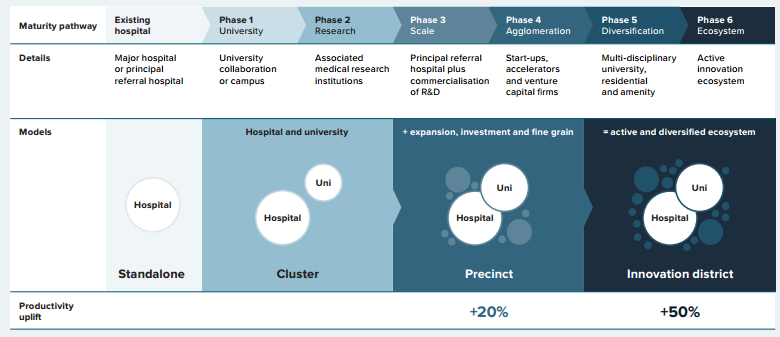
Getting it right: Creating a successful precinct As precincts evolve, they follow a maturity pathway (see Figure 8.4).65 Precincts maximise available economic and social benefits by attracting industry, mixed-use business and housing for workers and students. The most successful health and education precincts become innovation districts that are highly accessible. One example is the Gold Coast Health and Knowledge Precinct, which incorporates the Gold Coast University Hospital and Griffith University. This area is well-serviced by light rail, road, cycling and walking networks. This enhanced connectivity supports the precinct's ongoing development as a vibrant mixed-use community where residential, commercial and open spaces are co-located with the hospital and university.66 The benefits of creating precinct approaches to develop social infrastructure include staging infrastructure investment to unlock the strategic outcomes of the precinct, which opens up opportunities across a range of sectors. Figure 8.4: Precincts mature over time, unlocking ongoing value
Image source: Based on Greater Sydney Commission (2018)67 |