Consider cross-sector impacts
Governments should take a considered, strategic and standardised approach to evaluating the quadruple-bottom-line benefits of social infrastructure sectors by considering both their separate and their combined economic value.
For example, recreational infrastructure such as playing fields, swimming pools and sports centres help to relieve the significant economic burden of preventable disease on the health system by encouraging physical activity. These infrastructure assets also contribute to a healthy community by providing a hub for connection.
A 2019 Australian study found the burden of physical inactivity on annual health expenditure can be as high as $840 million. It also costs the economy up to $15.6 billion in annual production losses.81
" Governments should take a considered, strategic and standardised approach to evaluating the quadruple-bottom-line benefits of social infrastructure sectors. "
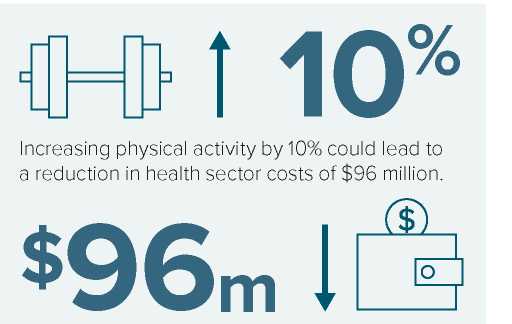
Supporting active lifestyles has the potential to substantially reduce health costs (see Figure 8.6).
Similarly, safe, stable and appropriate social housing has a flow-on effect, reducing costs to the health, education and Justice systems.
A consistent national social infrastructure valuation framework needs to be established to appropriately capture, prioritise, measure and assess the total economic value of social infrastructure so investment is more effective. The Sustainability and resilience chapter outlines the goal of establishing a quadruple bottom line for all infrastructure policy and investment decisions.
Figure 8.6: Recreational facilities reduce health care costs by supporting active lifestyles
Source: Cadilhac et al. (2011)82