Waste volumes are increasing
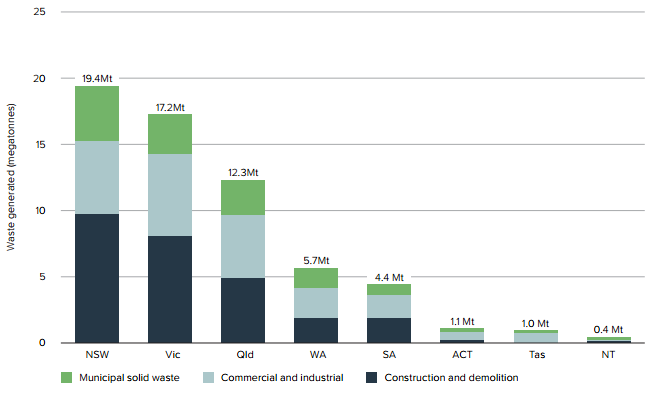
Australians produced 100% more waste in 2016-2017 than in 2002-2003.2 The waste sector primarily manages three source streams: municipal solid waste, commercial and industrial waste, and construction and demolition waste. Construction and demolition waste is our largest waste stream, followed by commercial and industrial waste and municipal residential waste (see Figure 9.1).
"Australia relies much more on landfill than other developed nations. "
The percentage of domestic waste could become even higher, following increases during the COVID-19 pandemic. Waste volumes shifted from industrial and commercial centres to residential areas as people spent more time at home. This led to a rise in online shopping and takeaway food delivery, so the volume of associated waste products also increased.3
Unprecedented levels of investment in housing and infrastructure have also generated record volumes of construction and demolition waste in recent years.4 Municipal solid waste and commercial and industrial waste have also grown, but more slowly.5 With a projected population of 37 million people in 2050, Australia's waste production could rise to 81 megatonnes a year by then.6
Waste volumes are heavily influenced by changes in population growth rates, demographics and disposable income levels. They also depend on society's attitudes towards waste disposal.
Australians are relatively enthusiastic recyclers, recovering 62% of waste materials through recycling and energy recovery in 2016-2017. Yet Australia relies much more on landfill than other developed nations.7
As the waste this country generates increases, traditional methods of disposing of, transporting and exporting waste are being impacted by legislative and policy changes, as well as growing community expectations due to a heightened awareness of people's impact on the environment.8
Figure 9.1: 20% of Australia's waste is generated in homes
Source: Department of Agriculture, Water and the Environment (2020)9
The waste sector is currently managed through a patchwork system of government regulations, with responsibility typically devolved to local government.10 While overall responsibility for waste management remains with state and territory governments through various health Acts, local governments have assumed an operations policy and compliance role focused on environmental protection, development approval and operational licensing.
The Australian Government's role is shaped by international treaties and objectives such as the Montreal Protocol, the International Convention for the Prevention of Pollution from Ships (MARPOL), the Basel Convention and broader environmental sustainability commitments.
Along with constitutional limitations, this piecemeal approach to policies and regulations has created distinct waste markets in each state and territory. One consequence is that waste is sometimes transported long distances from where it was generated to cheaper facilities.11
In addition, each form of waste is associated with differing supply chains, processing facilities, transport methods and regulatory frameworks.12
This interlaced network of waste transport, facilities and markets is under pressure on multiple fronts, and its complexity is blocking community understanding.
There are market failures in every component of the sector:
• Knowledge and compliance among consumers varies widely.
• Primary materials are increasingly expensive.
• Recovered/recycled products are often more expensive than primary materials.
• Supply chains are underdeveloped.
• Domestic end markets for recycled products and domestic secondary material manufacturing are lacking.
The 2019 Australian Infrastructure Audit identified a range of opportunities to boost economic growth and create employment by substantively reforming the waste sector.13 A critical first step will be implementing consistent, nationwide regulations, standards and policies.
The waste sector is a large system with many dependent aspects. Solving Australia's waste challenges can only be achieved by adopting a systems approach, rather than addressing individual components of the system in isolation.
While the 2021 Plan identifies key principles and components missing in the sector, Infrastructure Australia has focused on recommendations for governments and the sector that will:
• improve coordination and transparency
• develop a clear and equitable basis for assessing infrastructure need and its performance in the appropriate context
• identify the infrastructure needed for a domestic resource recovery market
• support the transition to a circular economy, acknowledging that systems-level change led by multiple stakeholders is required.