Need to strengthen domestic processing
Changes in the global market and a greater awareness of community waste production have shifted market dynamics for the waste processing sector. In response, the Australian Government announced a comprehensive waste export ban in August 2019.14
A staged timetable for different waste types begins in 2021, and most waste materials will need to be managed or pre-processed (in preparation for export) domestically by July 2024 (see Figure 9.2).15
Figure 9.2: An export ban will transform the waste sector between 2021 and 2024
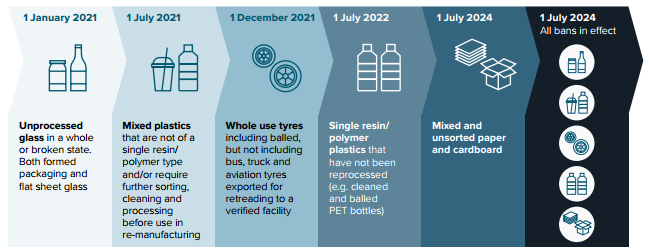
Source: Council of Australian Governments (2020)16
The ban represents a positive step towards creating a circular economy that will make Australia's approach to waste management more sustainable. For a detailed explanation of how this works, see Figure 9.4 in Reform 9.1 of this chapter.
However, this is a long-term goal. In the short term, the ban will put major pressure on domestic waste processing facilities.
To cope with increasing waste volumes, Australia needs the ability to recycle and reprocess much higher volumes of waste locally.
Unfortunately, a historical over-reliance on international markets to accept Australia's recyclable commodities has left domestic reuse markets and resource recovery infrastructure underdeveloped.17
The increased municipal waste volumes and border closures caused by the COVID-19 pandemic have further highlighted the need for change.
The waste export ban is an opportunity for reform across the sector that will deliver better economic and environmental outcomes. For example, developing new resource recovery markets that will enhance economic growth and create local jobs.
The waste sector is already a significant economic contributor. Approximately 50,000 people are directly employed in waste-related activities, and waste management services in Australia are valued at $17 billion per annum.18
To generate further economic growth, current perceptions of waste need to change so Australians recognise its value as a resource.