A more educated public
Embedding new attitudes will involve community education programs that improve people's general understanding of the waste management system. They also need to influence consumer behaviour, addressing issues such as illegal dumping and low resource recovery rates.19
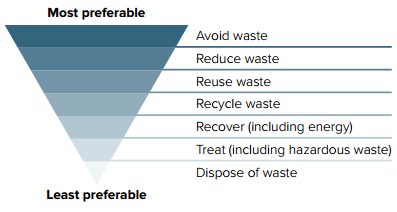
Changing awareness and understanding could transform Australia's consumption and production culture. It would cultivate greater self-sufficiency and product stewardship and create more markets for waste processing and recycling products. Ideally, Australia will stop producing waste where possible (see Figure 9.3).
Figure 9.3: Producing no waste is the ultimate goal of the waste reform hierarchy
Source: Australian Government (2018)20
Community understanding is already shifting. According to some studies, Australians say they are now more knowledgeable about landfills, household waste collection services and the use of recycled materials in new products.21
" A historical over-reliance on international markets to accept Australia's recyclable commodities has left domestic reuse markets and resource recovery infrastructure underdeveloped. "
For household generated waste, solutions relying on consumer behaviour, such as changing purchasing and consumption behaviour and separating waste for recycling, need to be supported by an increased understanding of the entire waste and recovery system.22
As CSIRO's Circular Economy Roadmap notes,23 it will take multiple communications channels to change people's thinking and guide their behaviour at home and work. There will need to be consistent public campaigns, product labelling for recycling, and instructions for households, industry and governments.24