Assessing the impact of policy recommendations
Multi-criteria analysis is often used in policy and project prioritisation processes to complement and target quantitative analyses (for example, cost-benefit analyses) that should be undertaken before implementing significant reform.
Infrastructure Australia has used multi-criteria analysis as a framework for qualitatively identifying the impacts and trade-offs for the recommendations in the 2021 Plan. We have also recently included best-practice guidance on its use in the Infrastructure Australia Assessment Frameworks.8
This multi-criteria analysis framework identifies the impacts of the recommendations across benefits for service users and community sustainability, risk and ease of implementation.
It provides a strategic framework for qualitatively assessing the potential impact and implementation challenges of each reform. Our aim is to help inform, rather than replace, a quantitative assessment such as a business case or regulatory impact statement before a decision is made.
This qualitative analysis is particularly important in the context of policy recommendations, where it is essential to consider impacts that are difficult or costly to monetise. These include:
• impacts related to governance or social equity issues, such as service availability across different places
• challenges, such as governance capacity
• risks, such as community acceptance, that could not be captured in a quantitative analysis.
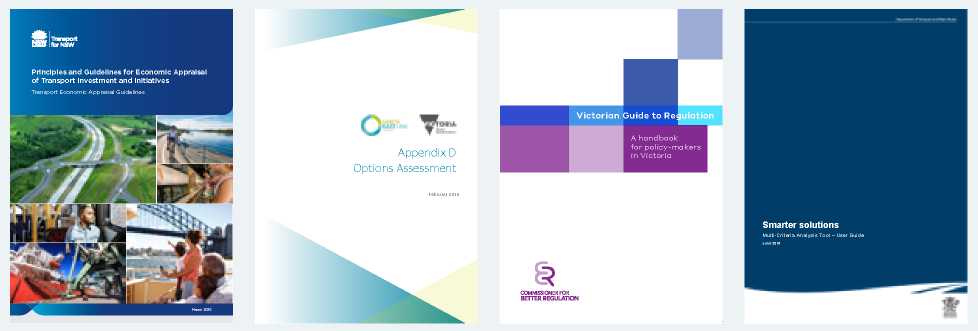
Where else is multi-criteria analysis used? Multi-criteria analysis is used frequently by government agencies to assess projects and policies. Examples include: • Transport for NSW's Principles and Guidelines for Economic Appraisal of Transport Investment and Initiatives, which describes multi-criteria analysis as an evaluation tool used for decision-making between a range of projects or options that are not easily quantifiable.9 • The North East Link Business Case Options Assessment, which used multi-criteria analysis to test the strategic merit of options before quantitative cost-benefit analysis was undertaken.10 • The Victorian Guide to Regulation, which identifies multi-criteria analysis as an appropriate tool for assessing policy effects that cannot easily be monetised, such as social equity outcomes.11 • The Queensland Government's Smarter Solutions: Multi-criteria Analysis Tool, which provides decision-makers with a framework for undertaking multi-criteria analysis, ensuring that a consistent approach is applied and that the structure of decision problems effectively captures the benefits and impacts of low-cost and non-infrastructure solutions.12
Source: Transport for NSW (2016), Victorian Government (2016, 2018), Queensland Government (2019) |