2. Stakeholders & Common Objective
There is a risk that the issue of PFI expiry can focus too narrowly on the relationship between the Authority and the SPV. Often the expiry issue is looked at as a zero-sum game between the Authority and the SPV. As the Inquiry notes, a significant issue of concern is that: 'While authorities will want to ensure they receive assets in the best possible condition at contract expiry, PFI providers have an incentive to limit spending on maintenance and improvement work in the final years of contracts, as savings can be used to pay higher returns to investors.'
Before narrowing the issue too quickly, however, it is helpful to look across the various stakeholders. All these stakeholders are important to a successful expiry. On examination, it is seen however that they are usually driven with a single purpose, albeit with some strongly divergent drivers.
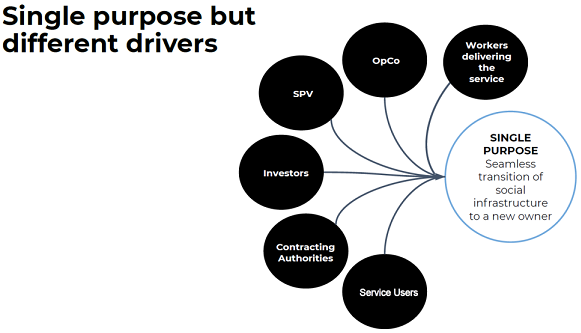
Notwithstanding their differing drivers, the key stakeholders relevant to expiry have a strongly aligned interest in seamlessly transitioning the infrastructure and service to a new owner, in whatever form that may be (see section 4. Opportunity, below). A notable aspect of a seamless transition should be 'no surprises'. There should be no surprises as to asset condition, information being handed over (in both scope & quality), cash flow, contractual and statutory compliance, etc.
While the public narrative in the UK appears to be against the value-for-money proposition offered by PFIs, it is important to acknowledge the emotional investment many of those working on PFIs often have in the quality of the services being delivered to the end-users of those services.
There is a usually a great degree of pride in the assets being managed: the stakeholders involved generally share an enthusiasm to see them maintained in good condition, both leading up to handover and in their legacy beyond. There is much of which to be proud. The recent Infrastructure Partnerships Australia research report on Social Infrastructure PPPs1 noted that in social infrastructure PPPs in Australia, the service providers (meaning those employees utilising the PPP capital assets to deliver services; such as school principals, doctors, wardens, administrative or management staff) are likely to become committed, and in some cases emotionally attached, to the PPP facility and its service provision. The report found that 95% of those service providers believe that their PPP project has delivered on the service promised by the relevant state government and delivery agency.
The report also found that 82% of those service providers expressed strong appreciation of the quality of services provided by the Facility Management (FM) operator. The satisfaction level with service quality was strongly influenced by the relationship between service providers, contract managers and FM operators. Collaborative working across stakeholders is considered key to the delivery of quality services and will likewise be key to successful PFI expiry.
It would be interesting to see if there was a substantial difference in views if such a study had been conducted in the UK. With the exception of some well-known issues, there is no reason to think that the same commitment and service does not generally apply in UK PFIs.
The expiry process should reinforce and support the desire of all stakeholders to achieve the single purpose, as they deal with their diverging drivers.
____________________________________________________________________________________________
1 Infrastructure Partnerships Australia 'Measuring the Value and Service Outcomes of Social Infrastructure PPPs in Australia and New Zealand' (April 2020)