| 4 | What are the key points when implementing collaborative procurement? |
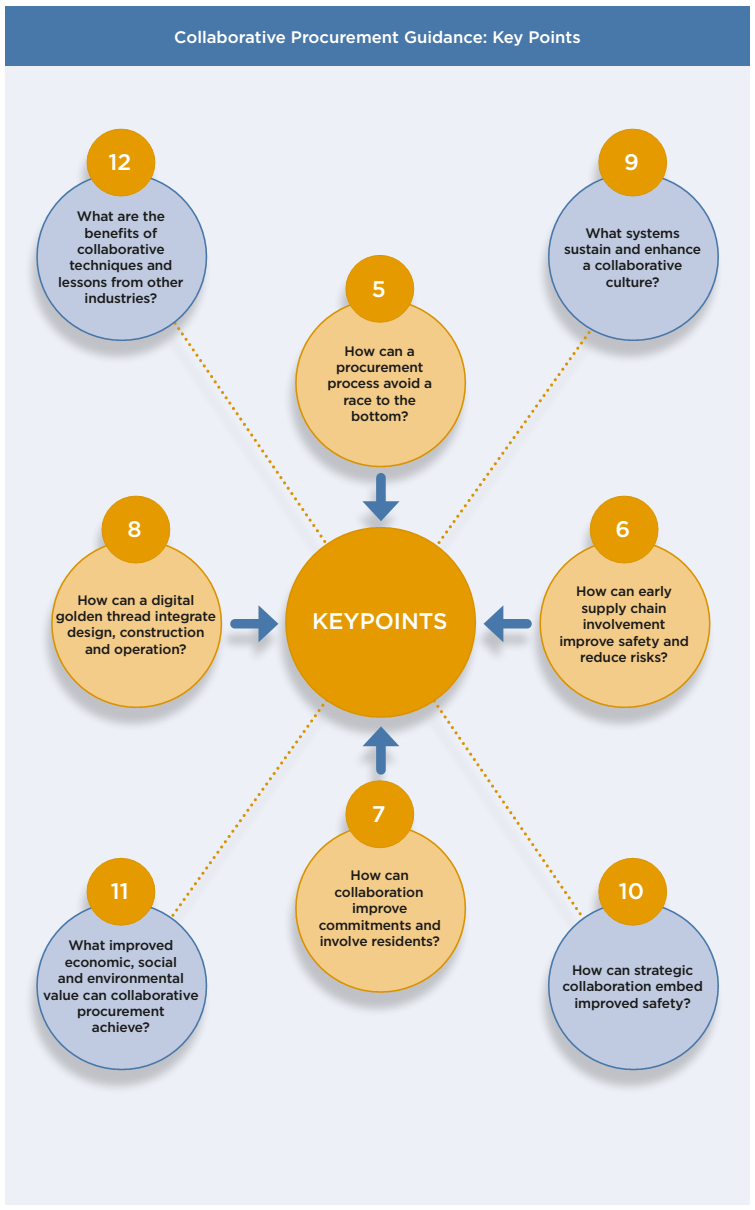
This section provides a summary of the key points that should be considered when implementing collaborative procurement on in-scope projects in the public sector or the private sector. These key points reflect the guidance in Sections 5 to 12 inclusive, and the summaries follow the same sequence of topics as those sections.
Key points - Section 5: How can a procurement process avoid a race to the bottom?
■ Avoid a single-stage, fixed price procurement process, especially if there is a risk that the Client may be provided with inaccurate fixed prices based on incomplete or inaccurate information (5.1)
■ Use a two-stage procurement process that enables early provisional appointments following which team members' tender proposals and commitments can be tested and improved upon before full implementation of the project is approved (5.2)
■ Assess competencies carefully against a recognised set of criteria to ensure that dutyholders and other team members can fulfil their commitments and obligations (5.3)
■ Ensure that evaluation criteria are detailed, measurable, weighted and accurately reflect the Client's brief and the principles of value-based procurement (5.4)
■ Demonstrate a robust balance between safety, cost and quality, using evaluation processes that demonstrate value and provide evidence of suitable competencies and insurances (5.5)
■ For public sector Clients, use the provisions of current Public Contracts Regulations that enable a balanced approach to assessing the most economically advantageous tenders (5.6).
Key points - Section 6: How can early supply chain involvement improve safety and reduce risks?
■ Appoint Principal Contractors, subcontractors and other supply chain members through early supply chain involvement ('ESI') following a value-based procurement process, so that they contribute their skills, knowledge and experience and so that they demonstrate behaviours that will optimise safety and quality (6.1)
■ Use ESI pre-construction phase processes to test how Principal Contractors, sub-contractors and other supply chain members can work with Clients and consultants to improve project outcomes and reduce risks (6.2)
■ Use ESI 'Supply Chain Collaboration' to optimise early contributions by selected subcontractors and other supply chain members during the pre-construction phase of the project (6.3)
■ Implement ESI to improve cost certainty and transparency by the separate agreement of appropriate profit and overheads and by active engagement with Principal Contractors, subcontractors and other supply chain members (6.4)
■ Use ESI to plan and agree integrated timescales and to manage changes (6.5)
■ Use forms of contract that provide integrated ESI systems and controls (6.6).
Key points - Section 7: How can collaboration improve commitments and involve residents?
■ Ensure that the roles and relationships agreed between project team members are demonstrably clear, collaborative and integrated (7.1)
■ Establish fair payment terms and cost models that eliminate late payment and support profitability (7.2)
■ Use transparent decision-making systems (7.3)
■ Use joint risk management by which appropriate team members agree the actions for dealing with each risk while accepting reasonable accountability (7.4)
■ Implement a consultation system to ensure that the views of resident representatives are notified, discussed and taken into account (7.5)
■ Make clear the contractual relationships and processes that support a collaborative culture (7.6).
Key points - Section 8: How can a digital golden thread integrate design, construction and operation?
■ Recognise the importance of sharing accurate and complete project information (8.1)
■ Use digital information management tools for the creation, sharing, storage and use of project information (8.2)
■ Consider how digital information can improve whole life asset management (8.3)
■ Use building information modelling ('BIM') to improve ESI processes (8.4)
■ Use BIM to improve collaborative procurement relationships and activities (8.5)
■ Consider how BIM contributions can be integrated using collaborative contracts (8.6).
Key points - Section 9: What systems sustain and enhance a collaborative culture?
■ Establish collaborative team leadership, management and quality control (9.1)
■ Agree a suitable system for developing accurate cost information and prices (9.2)
■ Consider and agree suitable incentives that will enhance relevant commitments (9.3)
■ Consider the benefits of systems for early warning and collaborative dispute resolution (9.4)
■ Consider the potential for project insurances to encourage collaborative behaviour (9.5).
Key points - Section 10: How can strategic collaboration embed improved safety?
■ Consider the potential for long-term collaborative contracting to embed improved safety and quality and other economic, social and environmental value (10.1)
■ Consider the potential of a ' framework alliance', including enhanced outputs from Supply Chain Collaboration (10.2)
■ Consider the potential of a 'term alliance' governing whole life asset management (10.3)
■ Identify where modern methods of construction ('MMC') can improve safety and offer other benefits (10.4)
■ Consider systems governing strategic performance measurement and incentives (10.5).
Key points - Section 11: What improved economic, social and environmental value can collaborative procurement achieve?
■ Assess and agree how collaborative procurement systems demonstrate improved value for the Client (11.1)
■ Assess and agree how collaborative procurement systems demonstrate improved value for Principal Designers, Principal Contractors and all other consultants, contractors, sub-contractors and other supply chain members (11.2)
■ Assess proposals for improved cost certainty and cost savings where these do not compromise safety or quality (11.3)
■ Assess the benefits of proposals for other improved economic value such as improved performance and extended warranties where these do not compromise safety or quality (11.4)
■ Assess the benefits of proposals for improved social value where these do not compromise safety or quality (11.5)
■ Assess the benefits of proposals for improved environmental value where these do not compromise safety or quality (11.6).
Key points - Section 12: What are the benefits of collaborative techniques and lessons from other industries?
■ Agree processes for developing trust and raising issues through early identification and collective resolution of problems so as to confront issues without being confrontational (12.1)
■ Apply systems for consensus-building and decision-making that encourage team members to air views and suggestions openly (12.2)
■ Agree how team members hold each other to account in terms of behaviours or performance without jeopardising collaborative working relationships (12.3)
■ Consider the benefits of independent advice and team coaching (12.4)
■ Consider techniques that improve collective performance in other industries (12.5).