7.1 Integrating collaborative commitments to safety and quality
In order for collaborative procurement to improve assurance as to the safety and quality of in-scope buildings, the team members need to be accountable for their designs, construction, manufacture and other work, and this accountability should be based on a clear understanding of how their different contributions fit together. Advance knowledge of each other's brief and proposals will mean that team members can base their work and warranties on more complete and accurate information. This is a major step away from the divisive project controls that are typical of many traditional procurement approaches and that give each team member only part of the picture.
The Client, Principal Designer, Principal Contractor, and all other team members involved in the preparation of Gateway applications, including the required plans and other documents, need new commercial and legal lenses through which to view their integrated commitments and through which to have a clear focus on issues arising.
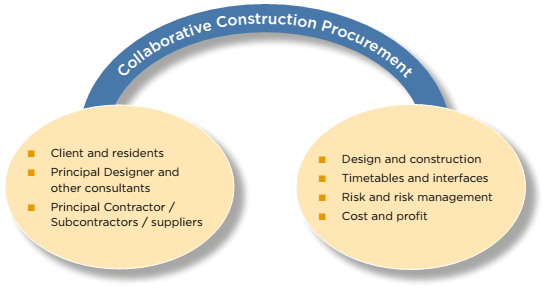
Systematic integration of the different team members' agreed commitments is essential to the success of collaborative approaches to team appointments, project planning, project delivery and information management. It can also:
■ Create new opportunities to ask and answer practical questions affecting risk and value
■ Avoid making incorrect risk and value assumptions
■ Establish what involvement, roles and responsibilities it is reasonable and valuable for all team members to accept.
Collaborative procurement is sometimes linked to contractual exclusions of liability and the suggestion that collaborative practices are undermined by the fear of claims for negligence. It is difficult,l to reconcile increased commitments to the safety and quality of in-scope buildings with contractual waivers that deprive clients and occupiers of their reasonable rights and remedies. Exclusions of liability, created by what are sometimes known as 'no blame' clauses, are not necessary for the collaborative procurement of an in-scope building. Instead, the systems and case studies in this guidance show how collaborative processes, relationships and activities give dutyholders the confidence to stand behind the outputs from their agreed roles and responsibilities, including their contributions to safety and quality and to other aspects of improved value and risk management.
Team integration combined with selection by value, ESI and efficient information management increase the confidence of team members in the quality of their work and of each other's work. These collaborative practices lead to innovations and improved value contributions without the need for changes to usual contractual duties of care.