10.2 The role of framework alliances
Significant evidence of improved results has led to the development and utilisation of collaborative contracts that support long-term framework alliances. The Construction Playbook promotes the use of frameworks as an efficient method to procure public works, goods and services, and emphasises that a 'successful framework contract should be based around principles that align objectives, success measures, targets and incentives so as to enable joint work on improving value and reducing risk'. It goes on to say that the 'FAC-1 framework is a good example of a standard form framework contract that can achieve this and many of the ambitions set out in this Playbook'.
A 2012 cross-industry working group collected evidence from Government departments and the wider public sector, and reported that benefits from the use of effective frameworks include 'good health and safety performance against national average' as well as 'sustainable efficiency savings', 'high client satisfaction rates', 'high proportion of value of work undertaken by small and medium-sized enterprises, 'high proportion of local labour and subcontractors', 'high take-up of government initiatives such as fair payment and apprenticeships' and 'high proportion of construction, demolition and excavation waste diverted from landfill'.
In 2016 the National Association of Construction Frameworks found that 'significant savings, benefits and other efficiencies in construction can be achieved by effective frameworks through the longer-term arrangements, non- adversarial relationships, common incentives, integrated teams and objective assessment of performance associated with such frameworks'.
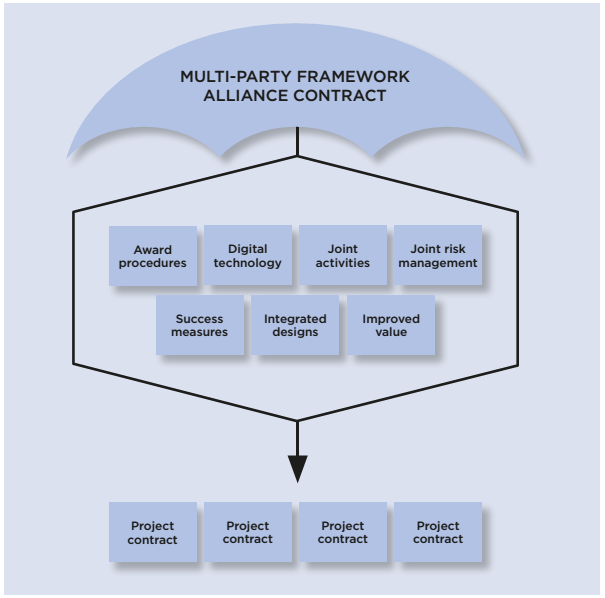
Consistent improvements in safety and quality over multiple projects can be captured through a framework alliance which sets out systems for awarding each project, systems for improving value and measures that establish an ongoing pipeline of work based on agreed levels of performance. A framework alliance can also ensure that all parties are aware of each other's roles and that they share their ideas for improved value on agreed terms as to intellectual property and confidentiality.
A framework alliance can act as a collaborative umbrella that connects and works in conjunction with any number of standard or bespoke two-party appointments. It integrates the work of one or more Clients seeking to award project contracts in respect of similar work programmes, who can benefit from aggregating their programmes and establishing consistent standards and working practices. The website for the FAC-1 framework alliance contract records numerous housing sector Clients who are using this form of contract to create and support collaborative alliances in respect of new build housing and programmes of refurbishment.
Example: The 'SCMG' Trial Project housing framework alliance, led by Hackney Homes and Homes for Haringey, was an FAC-1 prototype creating systems under which 'the project teams have a clear process for exchanging information on a collaborative basis at an early stage, with participants in early contractor involvement meetings working together to agree solutions that promote the best method of delivering the project. Often such discussions are led by the tier 1 contractor (with tier 2/3 support), so as to utilise experience from recent similar projects and to offer clear and well considered methods for the efficient delivery of the works.' |
Example: Epping Forest District Council procured a £22 million alliance for a programme of new homes, integrating a multi-disciplinary consultant design team led by ECD Architects with Airey Miller as employer's agent and cost consultant and a group of four contractors comprising Rooff, Neilcott, TSG and Indecon. The agreed FAC-1 objectives were: ■ 'To deliver high levels of end user satisfaction that improve and enhance the lives of those living in new homes ■ To deliver homes that are sustainable for the client and end users ■ To demonstrate value for money through both capital investment and whole life costs ■ To learn from shared experiences and to adapt, develop and improve the quality of new homes.' |
An effective framework alliance and an effective framework alliance contract should have the features recommended in 'Constructing the Gold Standard', the independent review of public sector construction frameworks commissioned by government in 2021. These features include a range of collaborative systems that prioritise building safety alongside delivery of net zero carbon targets and the Construction Playbook Compact with Industry. These features also include the agreement of 'gold standard action plans' by Clients and suppliers to convert framework objectives into actions and timetables that deliver improved economic, social and environmental value.