Executive Summary
| The Scottish Government is committed to all of Scotland's Public Sector buildings achieving net zero emissions by 2045 and for all publicly owned buildings to meet zero emission heating requirements by 2038. To achieve this, a step change in attitudes to energy use in the built environment is required. Public bodies have already demonstrated an ability to make significant reductions in emissions from their operational estates by working collaboratively to reshape them to better suit the needs of their users and the services which they support. These reductions have been achieved by refurbishing or repurposing existing buildings, co-location with partner organisations and other options that improve the efficiency of existing assets, as well as the construction of new ones.
|

In 2021, the Scottish Government published the Net Zero Public Sector Buildings Standard (the Standard) developed by the Net Zero team at the Scottish Futures Trust. This was developed in collaboration with Zero Waste Scotland and Health Facilities Scotland, with input from the wider Scottish construction and public sectors. This collaboration resulted in publication of a methodology which enables public bodies to meet their Net Zero (NZ) commitments for their new build and major refurbishment infrastructure projects.
The intent of this Standard and the counterpart Net Zero Public Sector Buildings Standard for Existing Buildings ('NZPSBS for Existing Buildings') is to set a clear route map to NZ within the Net Zero Deadlines set by each public sector organisation, and when reading this Guidance please refer to the latest version of the Standards.
Within the existing Scottish Public Estate, there are around 120 PFI, PPP, hub and NPD (collectively PPP) projects across the education, health, office and custodial sectors. These include major acute, mental health and primary healthcare facilities, as well as multiple schools' projects, many of which have been operational for in excess of 15 years.
The objective of this guidance is to provide direction on how to adopt a systematic approach to the delivery of a NZ transition within this unique sector. The guidance recognises the requirement for consistency in the design, implementation and monitoring of the transition. In doing so, it recognises that public bodies are unable independently to put in place effective carbon reduction strategies or to set carbon reduction targets. Due to the unique nature of operational PPP projects, the cooperation and collaboration of all interested parties including funders, investors, the project companies' management services providers and FM service providers, is required.
This document is not intended to provide exhaustive guidance for the design and implementation of NZ pathways for all public sector buildings or property in Scotland. Pathways tend to differ in the extent to which they focus on the use of technology, particularly those for greenhouse gas removal. These pathways are not mutually exclusive not least for operational buildings and facilities, because operational buildings and facilities are particularly challenging in reducing emissions in entirety, including those procured and operated under PPP arrangements.
This document focuses on the improvements which can currently be achieved under PPP arrangements. The Scottish requirements for public buildings to achieve zero direct emissions from heating, cooling and hot water (ZEH) by 2038 will be challenging and this guidance will require to be considered in conjunction with the developing direction from Scottish Government to meet the targets.
The pathway to NZ is fundamentally about reducing global greenhouse gas emissions rapidly and emitting as little greenhouse gas as possible on the way to 'net-zero' which will help minimise further changes in the climate. The guidance recognises that pathways to NZ can be wide ranging and need to address all greenhouse gases. Consequently, there are multiple 'pathways' which can be adopted in the Net Zero transition.
This guidance has been developed to assist the Public Sector in structuring the right questions and identifying the primary areas which will likely need to be addressed to successfully transition to NZ and to help minimise the impact of further changes in the climate during the transition period.
The core of the guidance focuses upon operational energy related carbon reduction, but there will undoubtably be other opportunities for broader carbon reduction in PPP assets and projects. This is particularly the case on some of the earlier PPP projects where the scope of the facilities management service includes an extensive range of non-building related services typically waste, water, travel, fleet and food, all of which are influenceable by the procuring public body and the PPP project company. Public bodies, when using this guidance, should do so in conjunction with their wider carbon footprint reduction strategies to limit the environmental impact of their service in the broader sense.
It is recognised that there are few commercial levers available to public sector participants operating PPP projects that enable them to enforce the required net zero related changes. Whilst contractual provisions do exist in the Change provisions of PPP contracts where project companies are formally obliged to implement a Change once formally instructed by the procuring Authority, the guidance, in the main, promotes a collaborative approach between the public and private sector stakeholders. It does so by recognising that it is likely that all parties will understand the benefits associated with adopting environmental, social, and governance (ESG) based approaches and that socially responsible/conscious investors will support the adoption of a net zero transition policy.
Scotland's public sector is already playing a strong leadership role in the national endeavour to deliver a just transition to NZ by 2045. Many Scottish public sector bodies have targets consistent with the national target to achieve NZ by 2045, and in some cases are pursuing efforts to achieve an earlier NZ transition date. For example, NHS Scotland aims to become a net-zero greenhouse gas emissions health service by 2040 or earlier in line with Scottish Government policy for NHS Scotland on the climate emergency and sustainable development and contained within the consultation draft NHS Scotland climate emergency and sustainability strategy 2022 to 2026 - draft.
This guidance therefore outlines how to plan, look at funding options and to deliver and manage the journey to net zero carbon which supports the wider Scottish Government objectives described above. This guidance gives both technical and non-technical guidance which is easy to understand and follow and its key objective is to recognise and explain the variances in approach which should be adopted on a PPP project.
The guidance identifies a process and measures to follow, so that discreet elements of existing operational PPP assets (including projects approaching handback) are on the path to NZ.
The guidance outlines how measures should be rolled out within contract lifetimes including as part of the asset handback process, where relevant.
Please see Figure 1 below which summarises the decarbonisation process for operational PPP projects and assets as described.
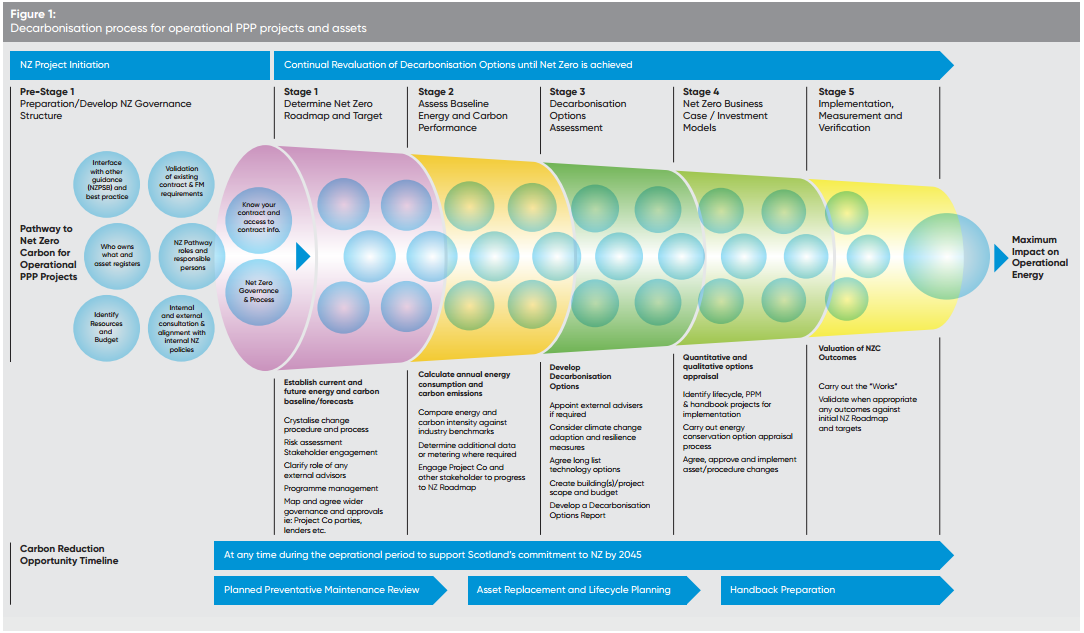
This guidance provides an overview of issues to be considered by public sector PPP practitioners, private sector providers and investors, ahead of implementing a net zero transition strategy. The focus of this guidance is on existing operational PPP facilities and buildings and is not intended to provide exhaustive guidance for the design and implementation of NZ pathways for all public sector buildings or property in Scotland.
It also provides templates and tools in relation to the physical alterations to facilities to transition discreet elements of operational PPP assets onto a pathway to net zero, in the context of Scottish Government policy and objectives. The guidance is not about operational energy management per se, although this is a key contributor to NZ for PPP projects. Public bodies, when using this guidance, should do so in conjunction with their wider carbon footprint reduction strategies, to limit the environmental impact of their service.
In summary this guidance:
a) outlines the need to transition discreet elements of existing operational PPP assets onto the path to net zero in the context of Scottish Government policy and objectives;
b) assists public sector PPP practitioners and technical teams to transition assets to the path to net zero through decarbonisation of existing facilities and system building elements via a net zero-driven approach;
c) provides a methodology to produce a net zero carbon roadmap to identify carbon reduction opportunities around lifecycle planning and potential alterations within a PPP context;
d) directs readers to other tools/guidance etc that might be useful; and
e) provides specific PPP support on contractual and other barriers to be overcome.
Further details can be found using the references to external guidance provided throughout, with active hyperlinks where publicly accessible, as well as a linked index in appendix 4 of this document.
This guidance has been designed to support public sector PPP practitioners, private sector providers and investors to manage better current operational assets in a way that helps to future proof investments and considers the impending requirements of the Scottish Government's route to net zero. It is recommended that Authorities using this guidance would take appropriate advice from technical, legal and other advisers as required in this regard.
If users have any questions in relation to this guidance or require any additional information, SFT can be contacted through the following email link: mailbox@scottishfuturestrust.org.uk