Conclusion 1: Net zero is creating a new era of change and opportunity
1. In 2019, the United Kingdom led the world's major economies in setting a target of net zero emissions by 2050. This single goal contained ambitious transformations for how we generate power, use our land, manufacture our goods, travel, and heat our homes. Net zero also implied a commitment to embracing the opportunities of a new technological era. It did all this, while doing our duty in the face of the great global challenge of our age: the extreme threats to the planet and humanity from greenhouse gas emissions (see 'The direct risks of climate change to the UK').
2. Progress since 2019 has exceeded expectations. In setting the net zero target, the UK was building on the progress of many years - not least a quiet transformation of our power system, from one dominated by coal to one increasingly driven by a clean and endless supply of wind blowing across the North Sea. Even still, the changes we have seen since setting net zero, both in the United Kingdom and globally, go far beyond what might have been expected in 2019. Today 91% of the global economy is committed to net zero.11 Renewable energy costs are dropping sharply (see Figure 1). UK offshore wind prices fell by 70% since 2014,i 12 with offshore, onshore, and solar dropping below the cost of fossil fuels, promising a society in the very near future where the sun and wind meet most of our energy needs.ii 13 Society is responding too. When asked about a range of issues, climate change was the second biggest concern facing adults in Great Britain (74%), with the rising cost of living being the main concern (79%).14
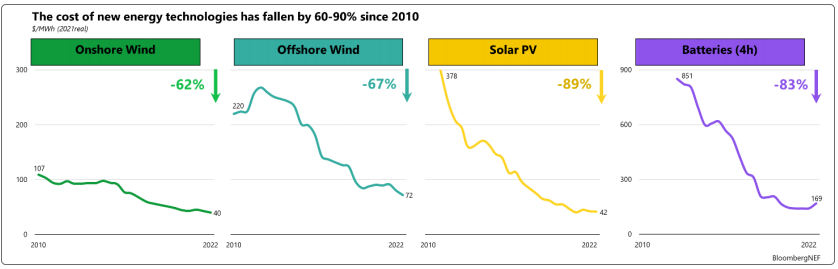
Figure 1 - The global cost of onshore wind, offshore wind, solar, and batteries 2010-2022 (Source: BNEF)
3. Net zero is the economic opportunity of the 21st century. The evidence presented to the review has shown that the pace of recent change has created a global rush of economic opportunity perhaps never seen before. From the $370 billion support for clean energy agreed by the United States Senate, to the European Green Deal's €600 billion green investment - the world is responding to this opportunity. A central question for this Review is how the UK can best position itself in this global marketplace. The opportunity on offer is huge. The global market opportunity for UK businesses from net zero could be worth more than £1 trillion in the period 2021 to 2030.15 If we seize it, we can usher in a new generation of UK businesses, providing high-skilled jobs for our generation and our children. Failure to compete globally risks missing this opportunity, seeing UK industries move away and other countries capturing the economic gains.
4. The UK is in a race to capture the economic benefits of net zero. Other major economies are acting to encourage investment and develop new technology and industries. Most notably, through the 2022 Inflation Reduction Act the USA has committed more than $370 billion to clean energy. Without fast and decisive action, this will see the UK losing opportunities to other countries and failing to position itself as a global partner for trade and collaboration around net zero. The costs of failing to act now are high.
5. Net zero can make household energy bills less exposed to volatile and high fossil fuel prices. The high cost of energy must be at the forefront of decision-making on net zero. The illegal invasion of Ukraine has dramatically changed the short-term landscape, creating new pressure on household bills, and increasing many countries' ambitions to secure their own national energy supply, including the UK's. There have been some suggestions that the path to net zero increased household energy costs or the UK's vulnerability to the kind of dramatic shock seen in Ukraine. The evidence does not support either assertion.
6. Energy costs in a decarbonised UK power system are expected to be lower. Recent analysis shows this is already happening in the EU. In 2022, with wind and solar reducing wholesale prices substantially and increased the share of renewables to consistently around 40% of total generation,16 the average wholesale electricity price was about 15% below the average of the first half of the year.17 New analysis from the Review also shows clearly that household-level decarbonisation measures in the UK can reduce average bills further. In some instances, policy decisions to slow down some green technologies (e.g. solar or energy efficiency) or delivery failures may have meant opportunities to make bills cheaper have been missed.18 Crucially, decreasing the energy system's dependence on fossil fuels will also free the UK from feeling the effects of their price volatility. This should help households as well as economic growth by bringing more certainty to individual and business financial planning and investment decisions.
7. Despite the opportunities, real challenges remain. Some of these challenges lie in delivering on UK ambition. The Review has seen persuasive evidence of the UK not matching world-leading ambition with world-leading delivery, with economic opportunities being lost due to a lack of consistent long-term policy or investment. The UK must also be alive to the risks of net zero reducing some sectors' global competitiveness in the short-term, even as it seizes the many opportunities for global leadership in others. Finally, for all the persuasive evidence that net zero will be a net benefit to UK households, bring cheaper bills, new jobs and cleaner air, there are genuine issues around affordability, accessibility and fairness that require a strong response.
8. The danger that climate change poses cannot be ignored. The Review was tasked with assessing how to deliver net zero in a pro-growth manner. The evidence of the scale of the opportunity is striking. However, this assessment must be made in the context of the global response to climate change - probably the largest single threat to humanity. We know that the world is still not moving fast enough to decarbonise. Accounting for the implementation of Nationally Determined Contributions (NDCs) up until 2030, the best estimate of peak temperature by the end of the century is in the range of 2.1°C to 2.9°C19 - bringing with it terrible threats to our species. For the UK the challenge lies in delivering on the ambitious targets it has set, and in continuing to show leadership on the world stage.
9. Decarbonising can be good for households and the economy. This Review brought together perhaps the largest collection of evidence and perspectives on net zero ever presented to the Government. We received over 1800 submissions to the Review's call for evidence from the public, business, charities, and academics. The Chair, Chris Skidmore MP, has led more than 50 roundtables, talking to over one thousand people. This included travelling to all four nations of the UK to hear how the challenges and opportunities of the transition differ across the country. This report draws extensively on this evidence, seeking to provide an accurate and balanced summary of the views expressed. Its conclusions are strengthened by new analysis completed for the Review, including new modelling of the impact of today's higher fossil fuel prices on how the UK reaches net zero and distributional analysis modelling of the impact of net zero policies on UK households. The evidence has led the Review to make recommendations, covering the economy, the power system, research, and the needs of individuals and communities. But most importantly, the evidence has pointed to one overwhelming conclusion:
10. An unstoppable and essential drive to decarbonise is re-shaping the global economy, bringing a new era of opportunity. The UK has a golden chance to grasp this opportunity - but it requires serious and renewed commitment, more than justified by the prize on offer and the cost of missing out.
_____________________________________________________________
i With the offshore wind Contracts for Difference 4 2022 strike price of 37.35 £/MWh and 2014 CfD 1 strike price of £115-120/MWh.
ii On Wednesday 2nd November 2022, over 70% of the GB electricity grid was powered by low carbon sources, with wind alone providing more than half of Britain's power.