Conclusion 3: The benefits of investing in net zero today outweigh the costs
25. Net zero needs significant investment. The Climate Change Committee (CCC) estimated that an additional £13.5 billion of investment will be needed in 2022, rising to £50-60 billion per year by the early 2030s to meet the UK's net zero goals.64 Around 85% of decarbonisation between 2020 and 2035 will involve low carbon technologies or fuels alone or in combination with behaviour change.65 This investment will primarily come from the private sector - and it is clear that significant capital is available globally. The private sector is ready to pay for net zero and expects high and secure returns on investment. Government investment has a crucial role to play in funding R&D, major infrastructure, and incentivising investment in early-stage technologies that will be critical for the transition.
26. Evidence suggests the benefits of net zero outweigh the costs. The CCC's comprehensive Carbon Budget 6 analysis has found that the direct costs of decarbonisation throughout the next 30 years will be less than 1% of UK GDP - and could potentially be lower than persisting with the status quo technologies, in the case that high global gas prices persist. In other analysis, work by Cambridge Econometrics for the CCC estimates that the UK would see approximately 2% additional growth in GDP when also considering the indirect economic effects of the transition, through the benefits from new jobs, increased economic activity, reduced fossil fuel imports and cost savings (e.g. cheaper household bills).66 These estimates do not reflect the potential increased risk and disruption of a course of inaction, which would be counter to the prevailing expectations of business and global trends described above.
27. The wider societal benefits will be higher still. The full story implies a much greater benefit. The CCC analysis does not quantify a number of critical factors which are difficult to model effectively or depend on how net zero is delivered rather than whether it happens at all. These include: minimising the costs of not acting on climate change (e.g. flood damage) and the benefits of cleaner air to people's health and productivity. Analysis from the Swiss Re Institute estimates that significant economic damage will occur, even with the fulfilment of pledges and targets on climate change. Relative to a world without climate change they estimate global GDP damages of 11% GDP if emissions rise in line with current policies.67
28. The rest of this chapter set out the broader economic opportunities, including from the growing global market for low-carbon goods and services and potential productivity gains.
29. The short-term benefits of government investing in net zero will primarily sit in making homes warmer, with people suffering less from the cold and benefitting from reduced energy bills as a result. New analysis from the Review also shows clearly that household-level decarbonisation measures in the UK can reduce average bills. With the Government liable to support energy companies' revenues as part of the Energy Price Guarantee, the savings to the exchequer from greater energy efficiency investment have never been higher.
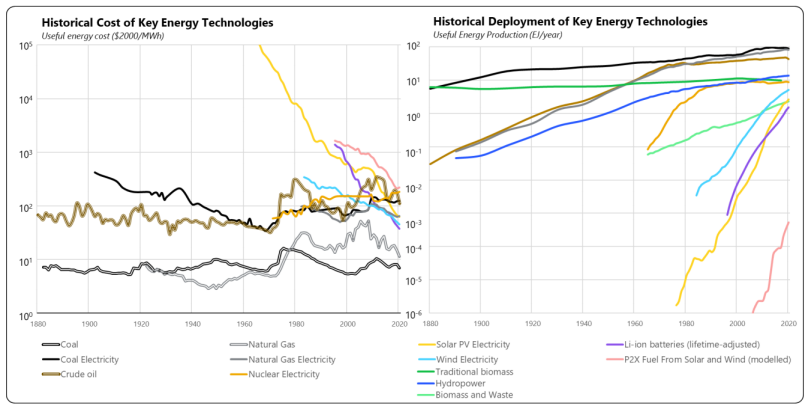
Figure 2 - Historical cost (left) and deployment (right) of key energy technologies
(Source: Way et al., 2022, 'Empirically grounded technology forecasts and the energy transition')
30. Investing now is cheaper than delaying. Office for Budget Responsibility (OBR) analysis suggests in their delayed action scenario that public sector debt could be 23% higher than in their early action scenario by 2050, thus doubling the fiscal impact of achieving net zero.68 Oxford research has shown that a 'fast transition' to net zero based on scaling up key green technologies will continue to drive their costs down, and transitioning to a decarbonised energy system based on green technologies by 2050 can save the world at least $12 trillion, compared to continuing our current levels of fossil fuel use.69 Recent evidence shows how technology costs can decrease as a result of significant investment. These trends have been observed most sharply for solar, biopower, wind, and batteries - which is good news for the net zero transition - see Figure 2.