2.5 System flexibility
The high penetration of renewable generation within the energy system comes with the challenge of supply side variability. Addressing this requires new thinking, smart systems and balancing demand and supply, to meet the 2035 fully decarbonised power sector ambition and phase out current, carbon-emitting sources of flexibility. Overall, the Review finds this to be an opportunity for the UK, delivered by UK businesses and benefiting consumers across the country. Estimates suggests flexibility services can lower the costs of our system by £10 billion-£17 billion a year by 2050, by reducing the amount of generation and network build needed to meet peak demand. It will create jobs, estimated at 24,000 by 2050, and drive investment across the UK. Schemes being rolled out across major energy providers this winter provide an insight to the possibilities for households to access some of these benefits. Consumers will play an active role, taking up new tariffs and adopting smart appliances that reward flexibility and balance supply and demand variability in a hands-off way. This will all be made possible by harnessing the power of data and digitalisation across our energy system. Key recommendations: • By 2024, government should set a strategy for its market for flexible capacity, including pathways for different technologies to 2035. • Government should continue to set ambitious targets for the remaining years of the four-year smart meter framework. • Ofgem should maintain focus on a timely implementation of its market-wide half-hourly settlement. |
287. There is a clear and rising need for flexibility in the UK's electricity system. Most studies suggest electricity demand by 2050 could be roughly double today's level of total electricity demand.227 The electricity system needs to match generation and demand on a second-by-second basis to keep system frequency stable and in balance. This can be particularly difficult given the behavioural patterns of residents, which tend to consume electricity at similar times as shown by Figure 2.10.228 System flexibility is the ability to adjust supply and demand to achieve that balance, and to help manage locational constraints on the networks over different timescales, from minutes or less to across seasons or even years. This is essential to keep the grid operational in periods of high stress and to ensure security of supply. Improving energy system flexibility is necessary for enabling cost-effective integration of low-carbon electricity generation, particularly renewables.
288. A flexible system is underpinned by data and digitalisation and Government set out a first Energy Digitalisation Strategy in 2021. Digitalisation is key to be able to handle the millions of energy flows and data points every second from low carbon technologies, such as heat pumps, solar, batteries, and electric vehicle charge points, connecting to the grid over the coming years.
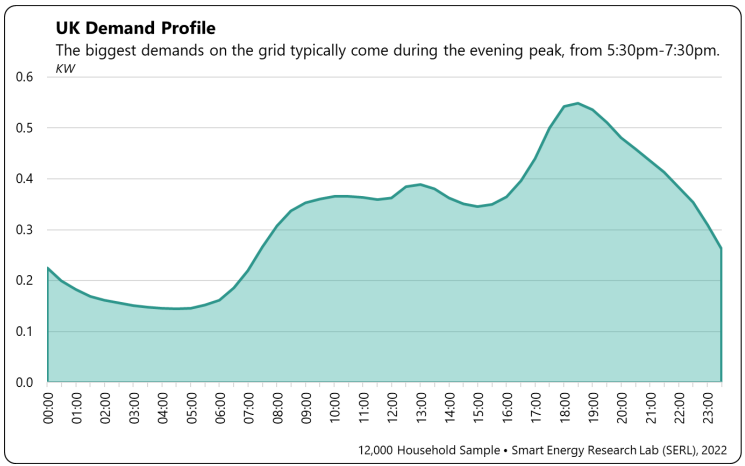
Figure 2.10 - Typical daily electricity demand profile for a UK household
289. The UK needs to change the provision of flexibility in the grid. Traditionally, flexibility has been provided through supply, by decreasing or ramping up supplies to meet incremental demands throughout the day. In this system, incremental increases in energy demands - or peaks - have typically been met by fossil gas peaker plants that provide the flexibility the grid needs. At current prices, these gas plants are extraordinarily expensive to run, feeding through to higher prices for households. Also, to ensure the UK meets its target to provide affordable, clean and secure electricity by 2035, gas or coal can no longer be called upon in the same capacity. Therefore, the UK needs to replace the role that gas plants currently hold - both the mid-merit roll to fill in the gaps between routine drop in wind and solar output, and as a hedge against longer, more sustained periods of supply gaps. To do this, a mixture of supply-side technologies will be required to perform these different roles, while smart management of energy demands will ensure undue costs are not passed on to households.
290. This is an opportunity for the UK. It will be delivered by UK businesses and will benefit consumers across the country. Studies show that a flexible grid could save the UK £10-17 billion per year by 2050 by reducing the need for dedicated back up generation for severe weather events and grid reinforcement requirements to meet peak demand,229 create an estimated 24,000 jobs by 2050, and drive investment across the UK.230