2.5.1 Supply-side flexibility
291. Future supply-side flexibility will be provided by storing renewable energy when it is abundant for use when it is scarce (temporal shift); draw-down from areas of high abundance to those where it is needed most (locational shift); or converting electricity into another low-carbon fuel using electrolysis for either direct use or storage (vector shift). This will need to happen at different scales; from multi-GW storage options and international interconnectors to domestic batteries and more local flexible solutions.
292. The Government and Ofgem set out their plan for managing supply side variability in the Smart Systems and Flexibility Plan.231 The Review found this comprehensive in setting out short duration (intra-day) solutions.
293. Stakeholders told the Review that government could provide more clarity on long duration (between day and beyond) solutions for managing so called dunkelflaute events, periods of low wind and low solar generation potential. There are a variety of methods that could be deployed to manage these events.
294. Long-duration storage of low carbon power could be achieved through various technologies, including pumped hydro storage, flow batteries and the conversion of power to hydrogen and back to electricity. Many of these are emerging technologies which have the potential to support growth and jobs. Government has not given indications of the proportional mix to deliver the required storage nor set out a market framework. This is impacting investment through insufficient demand signalling.
295. Multi-purpose interconnectors could provide the required flexibility drawing from international sources when conditions in the UK will not generate the required power from renewables and similarly can be used to export power at times of excess generation in the UK.
296. Dispatchable power may also play a role, including hydrogen, pumped hydro and gas, which will increasingly be abated with carbon capture technologies, known as power CCUS. According to BP, there remains "uncertainty of future demand for power CCUS capacity".232 General Electric recommends the Government clarifies expected volume for power CCUS by 2035 to provide confidence to investors and technology companies.233 Analysis shows that investment in 5GW of power-CCS by 2030, as opposed to the counterfactual of 1GW, would save £1.5 billion and 10MtCO2 by 2040, even if gas prices stayed at 2022 levels.234 The Government's call for evidence on the future policy framework for the delivery of power with CCUS stated that we may need to deploy up to 10GW of power CCUS by 2035. Currently however, investment and government support does not necessarily reflect this ambition since it is unclear how much of this will be deployed. Clarity on expected deployment would create an important demand signal for investors into power CCUS.
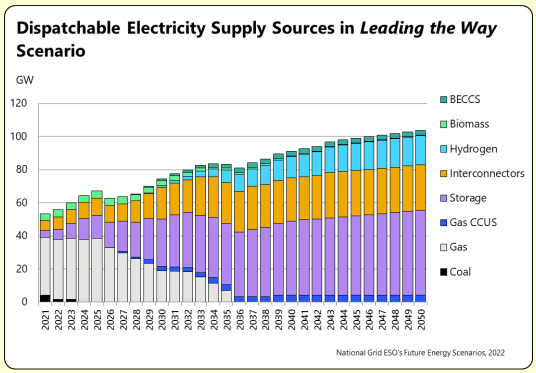
CASE STUDY: National Grid ESO'S Future Energy Scenarios While the Government remains agnostic to the mix of supply side solutions, National Grid ESO's Future Energy Scenarios provide an indication as to how future flexibility may be provided. In the most ambitious scenario, Leading the Way, the National Grid reaches 98% clean power by 2030 and energy storage capacity reaches 30GW (130 gigawatt-hours) by 2030, which would be dispatched instead of fossil gas. This storage is predominantly met by 20 GW (37 GWh) of batteries in 2030, up from 1.6 GW (1.6 GWh) in 2021 and 5GW (65GWh) of pumped hydro in 2030 up from 2.4GW (26 GWh) in 2021.235 Although gas will remain important to the broader energy system as a transitionary fuel, by 2035 unabated gas usage in the power sector makes up no more than around 2% of domestic generation under all scenarios, and in Leading the Way all unabated gas generation capacity is phased out by the end of 2035. This is mitigated by growth in interconnection, storage and hydrogen generation, as well as additional demand reduction from Demand Side Response technologies.236
Figure 2.11 - Dispatchable electricity supply sources in Leading the Way scenario |