2.7.4 Developing engineered Greenhouse Gas Removals
Engineered and nature-based greenhouse gas removals (GGRs) are essential for capturing residual emissions to enable the net zero transition. Engineered GGRs include direct air carbon capture and storage (DACCS) and bioenergy with carbon capture and storage (BECCS). Nature-based GGRs are discussed further in Pillars 3 and 6. The UK must create a market and incentivise investment into engineered GGRs and get them to scale. Doing so will support negative emission efforts and create new economic markets supporting growth and creation of jobs. Key recommendations • Government should announce, as soon as is possible, its intentions for engineered GGR business models including timings and eligibility. This announcement must clearly outline what standards these business models are expected to require. |
425. For some sectors like aviation and agriculture, residual emissions remain where emissions can't be captured at source of release as they would be with CCUS, or where no further feasible action can be taken to reduce emissions. It is therefore essential that the UK normalises the use of engineered greenhouse gas removal methods (GGRs) which capture emissions directly from the atmosphere if we are to meet our Net Zero 2050 target (see Figure 2.15 below).316
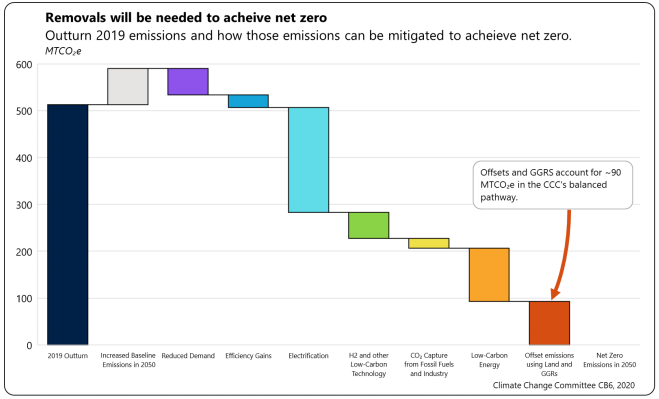
Figure 2.15 - Requirement of removals in the CCC's balanced net zero pathway
426. Direct air carbon capture and storage (DACCS) and bioenergy with carbon capture and storage (BECCS) are key engineered greenhouse gas removal methods (GGRs) that remove emissions directly from the atmosphere. These GGRs are in the early stages of development.
427. GGRs are vital to the delivery of the Net Zero Strategy. The Strategy committed to deploying at least 5MtCO2 per year of engineered removals by 2030, with modelling suggesting this could need to rise to 23MtCO2 per by 2035. However, the UK needs to accelerate development of the GGR industry if it is to capture the 40 to 100 MtCO2 p/a of residual emissions expected to remain in 2050.
428. Stakeholders such as CO2RE have been clear that it is vital we act now to ensure we have infrastructure in place to ensure a thriving GGR sector by 2050.
"It is generally accepted that to meet the UK's net zero obligation, the GGR sector will by 2050 need to be the size of the current power generation sector. That is an unprecedented rate of growth for a new sector which currently scarcely exists." - CO2RE317
429. Government is progressing this work. As outlined in the Net Zero Strategy, the long-term ambition is to have a competitive market for GGRs. To kick-start the integration of engineered GGRs into a market, government has consulted on (and is now analysing) a technology-neutral business model for a broad portfolio of early GGR projects.318
430. It is vitally important that, whilst engineered GGRs are essential to delivering on net zero, they should not be seen as a 'silver bullet' for decarbonisation, nor a substitute for reductions where they can reasonably be made. The UK Government is clear in this messaging when engaging on GGRs and must remain so.