3.3.1 The opportunity and the challenge
480. The Government estimates that the policies underpinning the Net Zero Strategy and the British Energy Security Strategy could support 480,000 green jobs by 2030, and the Energy Innovation Needs Assessment published by BEIS found that business opportunities identified from decarbonisation could support approximately 500,000 jobs in the UK by 2050341.
481. There is evidence that suggests that green jobs tend to offer higher wages.342 However, novel analysis by LSE Grantham Institute (forthcoming) on green jobs in the UK and the US suggests that, while green jobs tend to be created in better paid occupations, they are not necessarily better paid because of their greenness. More specifically, while for a given occupation (e.g. engineers) green jobs were generally better paid in the early 2010s than their non-green counterpart, wage premia have become more modest in recent years and vary considerably across occupations. Higher wages may reflect a mismatch in the supply and demand of certain skills, as well as productivity levels in different sectors. For example, gross value added (GVA) per worker for industries such as offshore wind and CCUS remain higher than the UK average.343
482. The UK can seize opportunities for levelling up as part of place-based impacts of the transition. For example, there are growth opportunities in CCUS and low carbon hydrogen which can create jobs in Merseyside, Humberside, Scotland and South Wales. Similarly, opportunities in environmental development (tree planting, peatland and seagrass restoration and urban green infrastructure) exist in the 20% of British constituencies facing the most significant employment challenges.344 345 Job returns on investments in nature-based solutions (like tree planting or peat restoration projects) are high in comparison to other sectors in the economy; on average, investments in nature-based solutions have around ten times the job creation rate of investments in fossil fuels.346
483. The LSE analysis of UK vacancy data mentioned above shows that low-carbon jobs are more spatially dispersed than high-carbon ones. This is promising in that the net zero transition could bring about economic opportunities across the UK.
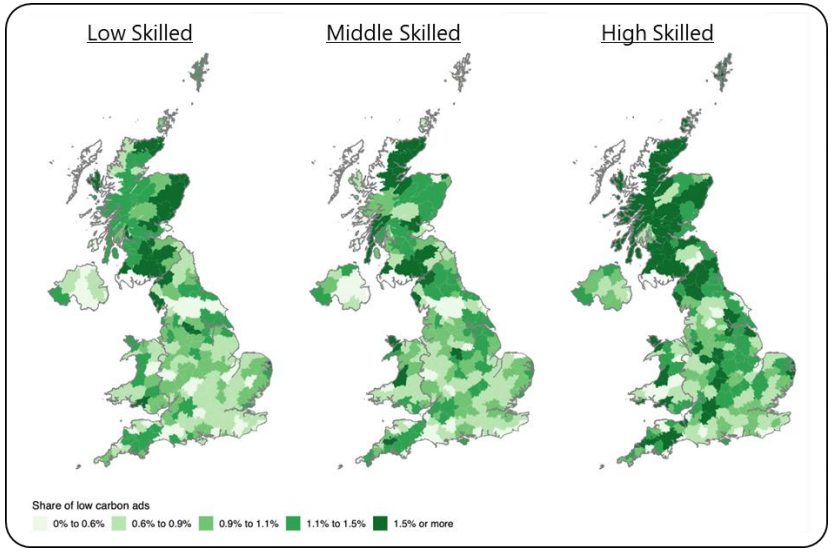
Figure 3.2 - Spatial distribution of low-carbon vacancies at different skill levels347
484. However, disparities are already emerging. Regional analysis in PwC's Green Jobs Barometer348 found that the lowest-scoring regions on the overall Barometer Index were Northern Ireland, the North East, and the East Midlands. "Although every region of the UK is experiencing significant green job creation, the rapid increase is disproportionately concentrated in London and the South East".349 On gender, Onward found that "in net zero industries, approximately 82% of employees are male and just 18% are female".350 While gender balance is marginally better than in incumbent industries, policies are required to tackle this for the future.
485. To ensure that future green jobs are created here, we must ensure that the UK has the right pipeline and mix of skills to deliver the transition. Industry has been clear that having the right skills in the economy is critical for achieving net zero, capitalising on growth opportunities available to the UK, and ensuring that the transition brings these high-quality jobs across the country.
486. Skills challenges were raised in engagement with almost all sectors. To capture the jobs growth opportunities from net zero, the UK needs a shift in mindset about the mix of skills we need in the economy across all sectors.
487. This challenge is exacerbated by an existing decline in skills in some sectors of the economy that are critical to the transition. Some crucial areas show concerning existing skills gaps, including tradespeople, where depending on the sector, we have seen a 5-30% decline over the past three years,351 undermining the UK's ability to undertake retrofitting and install heat pumps, and construction, where 50% of Federation of Master Builders members report challenges recruiting for key trades including bricklaying and carpentry.352
"To build, renovate and retrofit the good homes of the future, the UK will need to reverse its recent decline in the numbers of tradespeople ready to work." - Kingfisher353
"On the ground there is a lack of confidence that the skills are there to deliver retrofit projects, which is holding back our investment when we can see the return." - Venture capital firm354
488. The UK Government set out to tackle this challenge by establishing the Green Jobs Taskforce in 2020 to "set the direction for the job market as we transition to a high-skill, low carbon economy."355 The Taskforce, comprising of a diverse group from industry, academia, unions and the education and skills community, produced an advisory report to Government, recommendations of which are yet to be fully implemented.
489. The Green Jobs Taskforce Report made a thorough assessment of the opportunities and impacts of the transition and received broad cross-sector support for its recommendations.356 It categorised sectors into three groups that will experience emerging skills demands in different ways:
• Well-established green sectors which will experience significant growth - for example, offshore wind, electricity networks, smart systems technologies, buildings retrofit and construction of new builds.
• Green sectors that are predicted to grow ahead of the transition - for example, hydrogen, CCUS, climate resilience, nature conservation and restoration.
• Sectors experiencing significant transformation - e.g., automotive, heating and cooling, circular economy and resource efficiency, and oil and gas.
490. The Report emphasised the importance of cross-cutting skills: Science, Technology, Engineering and Mathematics (STEM) skills, but also digital and data, project management, education communication and change management, and leadership, management and communication.
491. Industry views heard by the Review reinforced many of the challenges raised by the Green Jobs Taskforce and reiterated ongoing and future concerns about having the right skills in the economy, suggesting insufficient confidence that progress is being made.
492. Challenges we have heard from industry through this Review include:
• confidence in existence and longevity of jobs
• access to and affordability of skills provision
• training and retraining skills pipeline
• parity of esteem for entrants into trade vocations
• rate of movement of workers between jobs
493. The solution relies on clear long-term policy (see Pillar 1) support to help people access training and re-training (and know where the opportunities lie), clear and coherent training pathways - including the role of the education sector in building STEM skills from school age to higher education - and building capacity in local areas where the jobs of the future will be created.
494. Stakeholders also pointed out that long-term policy certainty could benefit net zero skills development. Long-term commitment to support for priority net zero technologies will give employers the confidence to invest in skills development. Moreover, a significant gap exists between the scale of the skills challenge at national level and local plans for skills development.
495. Government should drive forward delivery of the recommendations of the Green Jobs Taskforce and the commitments from the Net Zero Strategy. Publish an action plan for Net Zero skills that includes a comprehensive roadmap of when, where, and in which sectors there will be skills needs specific to net zero. This should include clear public targets for green skills action and governance to regularly track and report against these. Government should look to report on progress made by the Green Jobs Delivery Group on a regular basis, starting by mid-2023.