3.5 SMEs as active participants in net zero
518. SMEs face specific barriers to participating fully in the net zero transition - targeted support offers from government can amplify a growing will to 'take action' on net zero and allow SMEs to share in the benefits alongside larger businesses.
519. We know from the Federation of Small Businesses (FSB) that there is a clear and growing appetite among small businesses and others to do more.
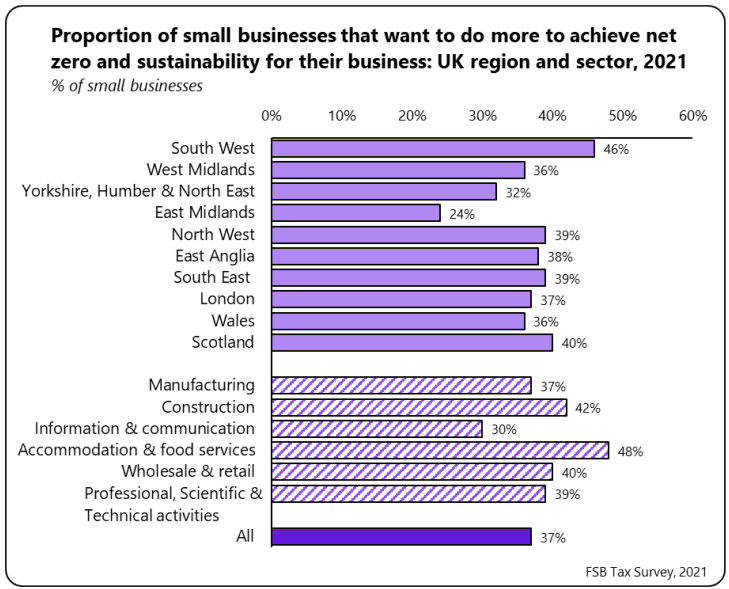
Figure 3.3 - Proportion of small businesses who want to do more to achieve net zero and sustainability for their business367
520. SMEs are a core target for growth and the future of net zero. Analysis by the British Business Bank found that SMEs account for almost one third of all UK emissions and around half of total UK business emissions.368 However, big businesses can more easily participate in net zero, and can better minimise costs and maximise financial benefits.
521. Government needs to act to enable SMEs to actively participate and benefit from the net zero transition. Evidence from the British Business Bank suggests most small businesses are at an early stage in their transition to net zero, with the most commonly perceived barriers to action around cost and feasibility.369 Access to finance is part of the solution to drive more action.
522. Small businesses could play a more active role in the net zero transition, but they are often constrained by time and cost. Information needs to be easily accessible and simplified for SMEs to digest given the resources they have if they are to identify decarbonisation opportunities and measure their own emissions.
"Create simpler engagement mechanisms for SMEs to engage with NetZero (and the broader sustainable issues across social value frameworks). Barriers of time and cost should be addressed to encourage businesses to begin their transformational journey. Less than 10% of UK SMEs currently attempt to measure their carbon emissions, progress needs to be made quickly to deliver Net Zero." - Scope Zero370
523. Additionally, SMEs often do not have the capital to pay the upfront costs and if they do the payback period for net zero initiative can be uncomfortably long.
524. SMEs need to be empowered to take actions to improve the greenhouse gas emissions impact of their business and capitalise on the financial benefits from the transition.
• Utilise role models. In the construction sector, as part of the CO2nstruct Zero programme, the Construction Leadership Council has recognised the importance of promoting role models for other businesses and the self-employed with action on net zero.371 This looks to provide evidence on the steps taken to decarbonise, provide case study material and work with their trade association to signpost other businesses within their sector on action to take.
• Better signposting. The Government has had limited success in signposting smaller businesses to the type of support currently offered.
"There is mixed awareness of the support and technologies available, which could be addressed through schemes like Help to Grow and Made Smarter." - Industrial manufacturer372
"The majority of UK SMEs tend to turn to government website and support schemes. This speaks to the importance of improving the quantity and the quality of information available on the platforms to accelerate decarbonisation." - Zero Emissions Enterprise (ZEE) Network373
• Reducing the 'prisoner effect'. Too often green actions by small businesses are constrained due to their tenant status in a building. SMEs and landlords should be working in collaboration to change the built environment.
"One of the key barriers faced by small businesses, for example, wishing to become more energy efficient, are the restrictions found within their tenancy and lease agreements, which may restrict if and what they can install in terms of energy-efficiency measures."
- Federation of Small Businesses (FSB)374
• Impacting SMEs via policies aimed at larger firms: small businesses are often subcontractors to larger businesses and so policy aimed at larger businesses should also be considering the impact on small businesses.
"This needs to be done with sensitivity, as direct requirements of certain standards from subcontractors might disadvantage smaller firms and disturb balance of competition on the market" - Zero Emissions Enterprise (ZEE) Network375
525. Tax incentives matter for SMEs too. Evidence from the OECD suggests there is greater additionality - that is, direct funding being effective in stimulating additional investment - from R&D tax credits for smaller firms than larger firms,376 Smaller firms have a lower tendency to make investments in research and development. We have heard these incentives could be used via similar model to deliver greater investment more broadly.
"...changes in a number of areas could help facilitate investment and deliver of transition to net zero: Develop stronger tax incentives to enable businesses and consortia to deliver and develop NZC services - examples of this include a similar model to the R&D tax credit"
- University of York, BioYorkshire377
"[The UK] should have a version of the R&D tax credit system [for] net zero as a means to incentivise. Alleviates the cost burden and we could mirror existing models thus should be swift to establish and implement" - Engineering company378
526. This matters for both the business as a whole and for incentivising their employees:
"Government should create tax-efficient schemes for organisations to encourage their employees to become NetZero; how they heat, and light, their homes, travel to work and work-based activities, take their holidays and invest for the future via pension schemes." - Scope Zero379
527. Energy use by businesses is a major source of their emissions,380 and there is evidence that SMEs are aware of the benefits of energy efficiency.381 In 2020, the Carbon Trust found that over 80% of SMEs surveyed were acting on energy efficiency and 51% saying they want to do more, but a lack of time and money is the most cited barrier to further action.382
528. However, this year the ability of small businesses to invest has faltered:
"By January 2022, evidence from the FSB found that only 22% of small businesses had plans to invest in net zero over the following 24 months. Since the beginning of the year, inflationary pressures have further diminished small businesses' ability to invest, while successful applications for credit are at an all-time low (46.2%).
"We believe that without further fiscal intervention, many small businesses will be forced to focus on business survival instead of investing in microgeneration or energy efficiency measures." - FSB383
529. The Review therefore recommends that part of the wider review of the tax system to incentivise investment in decarbonisation should include SMEs and consider incentives to improve their uptake of energy efficiency technologies.
Building on the UK Business Climate Hub, Government should launch a 'Help to Grow Green' campaign, offering information, resources and vouchers for SMEs to plan and invest in the transition by 2024. |
Government should develop an SME role models programme, which provides mentoring for micro businesses and the self-employed by 2023. |
Government should establish a taskforce of suppliers, small business landlords and business groups to agree on how to cut energy use in rented premises by 2023. |