3.6.5 Circular economy, resources, and waste
593. A more ambitious approach to managing waste and encouraging re-use and recycling could decrease emissions and provide significant economic opportunity. UK policy on this issue has been too slow and is failing to grasp these opportunities.
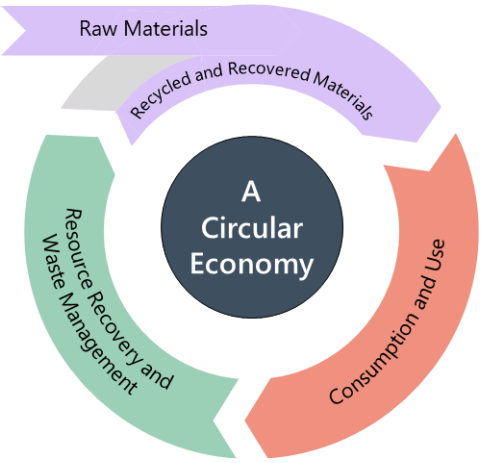
Figure 3.5 - Flow of resources in a circular economy414
594. How the UK handles things we no longer need is a crucial issue for achieving net zero. Waste and wastewater together accounted for 4.2% of UK greenhouse gas emissions in 2019;415 much of these come from methane emitted by biodegradable waste breaking down either in landfill or during wastewater treatment.
595. The Government set out its ranking of waste management options according to what is best for the environment in the Waste Hierarchy. This states that we should prioritise in the following order: waste should first be prevented at source; where this is not possible it should be prepared for re-use (repaired or refurbished); if not possible it should be recycled into a new product or material; if that is not possible then it should be recovered in some other way (disposed of in some way that recovers energy, for example via anaerobic digestion); then finally, if none of the above options are available, it should be disposed of via landfill or incineration.416 These rankings form the underlying principles for a resource-efficient and circular economy.
596. Climate Change Committee (CCC) analysis suggests that greater resource efficiency can drive up to half of the industrial abatement in the early 2020s and will play a significant role out to 2050.
"Research from the Centre for Industrial Energy, Materials and Products (CIEMAP) reveals that improving material use could reduce emissions by nearly 200 MtCO2e by 2032. The modelled savings all fall in the scope of domestic targets, and would mainly come during the fourth and fifth carbon budgets from five key sectors: construction, vehicles, food and drink, electronics and appliances, and clothing and textiles. Construction alone accounts for over half of the reduction."417