4.1.6 Better capacity and capability support
788. Net zero action is often a complex area, which some local authorities are still developing the specialist skills to successfully navigate. The picture also varies across the UK - while there are many local authorities with ambitious net zero targets, in 2021 there were 84 with no published net zero plan.553 Published plans vary greatly in quality and ambition.
789. The Review heard that capacity and capability is one area that presents challenges in this regard. For example, West Yorkshire Combined Authority told the Review that a "lack of dedicated capacity and specialist expertise slows progress, resulting in fewer projects being developed and delivered".554
790. When it comes to attracting investment and private finance, the UK Cities Climate Investment Commission found that:
"There is a gap in available headcount within Local Authorities to deliver this work [...] Nor are there centralised resources adequate for Local Authorities to draw upon."555
791. This represents a missed opportunity to create areas of competitive advantage for the UK.
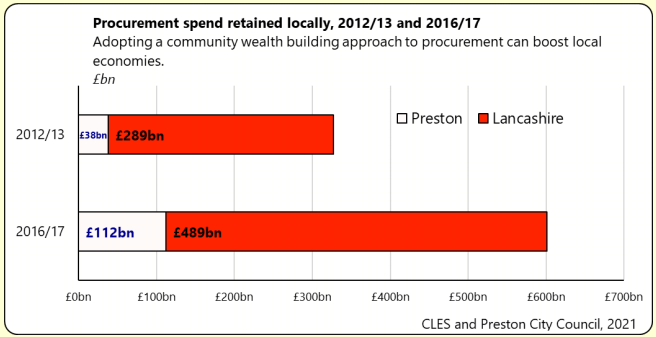
CASE STUDY: Local Net Zero Investment The transition to net zero can be supported by driving innovation in the local private sector to ensure that the opportunities of net zero lead to real benefits for local communities in terms of jobs, skills and pride in place. Preston in Lancashire is regarded as one of the UK's pioneers of community wealth building, an approach to local economic development focused on using a community's existing assets to create inclusive and local growth. Since 2012 the City Council has worked with other 'anchor institutions' in Preston - such as NHS trusts, universities, housing associations, and large local businesses - to use its influence as an employer, an owner of land and other assets, a major purchaser of goods and services and as a leader of place to reduce the wealth flowing out of the local economy so that it can be retained and shared more widely for the benefit of local people. The figure below shows Preston's success in using community wealth building to retain procurement spend locally. Compared to place-agnostic procurement in 2012/13, prioritising procurement from local and socially responsible businesses led to spend within Preston increasing from 5% to 18% of total procurement spend, and spend within Lancashire increasing from 39% to 79% of total procurement spend.
Figure 4.4 - Benefits of a community wealth building approach Following Preston's example, multiple local areas across the UK are pursuing community wealth building approaches, including in their strategies to delivering net zero. For example, research conducted by the Centre for Local Economic Strategies (CLES) and the Institute for Public Policy Research (IPPR) on behalf of South of Scotland Enterprise has found that a holistic effort will be necessary to develop the retrofit supply chain in the region. The research found that bringing together key anchor institutions in the South of Scotland, including registered social landlords, local authorities, and colleges, would create a combined economic buying power to support innovation and demand for net zero delivery in the local economy. This could see the creation of more than 2,000 jobs and £112 million in direct GVA by 2030.556 In North Ayrshire, the Council has pioneered the use of community wealth building to deliver renewable wind and solar energy which is delivering tangible benefits back into local communities. In addition to creating renewable energy and green employment opportunities, new solar PV farms will use council-owned land and assets to support the potential for local suppliers and supply chains to benefit from the investment.557 |
792. Local leaders have already started building net zero clusters that are attracting substantial green investment and jobs. As an illustrative example of the regional economic benefits that the net zero transition can accrue, analysis for the Net Zero Strategy suggested that the North East of England region will likely benefit from the transition to net zero through 27,000 additional jobs and £1.9 billion of gross value added by 2050.558
793. As a practical example of attracting green investment, research from 2020 on two EU programmes providing technical assistance for local net zero projects found that €23 million in grants delivered around €859 million of investment into UK programmes. This included Manchester Combined Authority using €3 million of initial funding to attract over €155 million of capital investment in the city.559
794. While this shows what is possible in terms of leveraging private finance, the Review heard that often areas lack the skills to turn opportunities into investible propositions, or to turn one promising project into a coherent net zero programme of growth.
"Many places have projects they would like to attract investment into, and many investors are looking for projects, but too frequently the projects are not presented in a truly investable manner [...] In broad terms, places and their leadership know what needs to be done. Again, in broad terms, the local population are behind these plans, and in many cases clamouring for them to happen more quickly" - 3Ci560
795. Despite their local success, Manchester City Council told the Review that:
"One of the biggest challenges at the local level is how to finance the climate transition and enable investment that will deliver new jobs and skills, deep decarbonisation and a more climate resilient city."561
796. The Review heard from many in local government that aggregating projects to an investible size and scale is a challenge, and that this is exacerbated by the short-term and piecemeal nature of central government funding.
797. Government must provide additional support to make sure regions can attract green investment and build regional green clusters. This should include refocusing planned Investment Zones to ensure they encourage net zero investment and development. A community wealth building approach could also be an effective way to develop net zero supply chains locally and ensure that local net zero projects drive economic growth throughout the UK. Central government should work closely with the UK Infrastructure Bank (UKIB) to build on its local pilots and its work providing an advisory function to local authorities.
798. More broadly, research for the Climate Change Committee (CCC) found that:
"[I]n most local authorities, capacity to tackle emissions reductions, apply for funding and manage schemes is very limited."562
799. For local authorities, the question of how best to use limited resource has become more challenging due to a reduction in overall funding and pressure on other delivery areas and statutory duties.
800. There was concern through the Review's engagement that smaller local authorities face particular challenges on net zero capacity and capability, and that too often this results in individual local authorities procuring expensive consultancy services to help with their plans.
801. The Review heard that the Government's Local Net Zero Hubs have been helpful in this regard, as they have been able to organise a consortium approach to drive down costs and use scale to mobilise regional supply chains. Government should continue to support the Hubs.
802. While the reforms laid out earlier in this Pillar will go some way to improving local capacity and capability - for example, by reducing the administrative burden of securing funding, and providing longer-term certainty around which local authorities can plan future action - central government must do more to support local government's capacity and capability on net zero.
803. The 'Office for Net Zero Delivery' (see Part 1) should provide central support to enable local net zero delivery, working with local authorities and the Local Net Zero Hubs to identify particular areas of need and ensuring effective join-up across regions to minimise costs on measures such as training or consultancy.
804. All councils should be required to have a Cabinet lead for net zero, and councils should be encouraged to give regular progress updates at public meetings on their net zero plans.
805. The Department for Transport's Local Authority Toolkit on transport decarbonisation provides one model through which local capability can be supported. The Toolkit highlights the benefits of different interventions, sets out the actions local authorities can take, helps share best practice and signposts to other guidance and methodologies. Net Zero Go, part of Energy Systems Catapult, is another example, which brings together tools and features to support local authorities in progressing energy projects and building businesses cases.