4.2.2 Turbocharging community energy
Government should commit to the Local Electricity Bill and publish a Community Energy Strategy that addresses regulatory, legislative, funding and capacity barriers in the sector. The Strategy should also consider what support should be given to innovative projects such as community purchasing and community energy sharing and storage. |
846. Community energy involves delivering renewable energy projects that are at least partly owned, led and/or controlled directly by communities. Community energy projects not only contribute to net zero but are a distilled example of energy security and sovereignty, with many communities moving towards a goal of energy self-sufficiency.
847. Despite increasing concerns around energy security and energy prices, the community energy sector has been relatively neglected by government. The rate of growth in the sector has slowed since 2017, with government support tapering off despite success (see Figure 4.5 below). Community Energy England, a representative organisation with over 280 members, told the Review that in the North West of England, projects from the previous government funding scheme had a "nearly 70:1 ratio of finance to development money", meaning that less than £1 million of development funding could enable projects with a capital expenditure of more than £64 million.579 Ending this support represents a missed opportunity for Government.
848. Current regulations in the energy market mean that community energy projects cannot directly supply local communities, an issue which the Local Electricity Bill seeks to address. Community-owned projects can also face disadvantages in accessing government or private finance. The Environmental Audit Committee told the Review that the UK is "lagging behind nations such as Germany, Denmark and the Netherlands in growing the sector".580
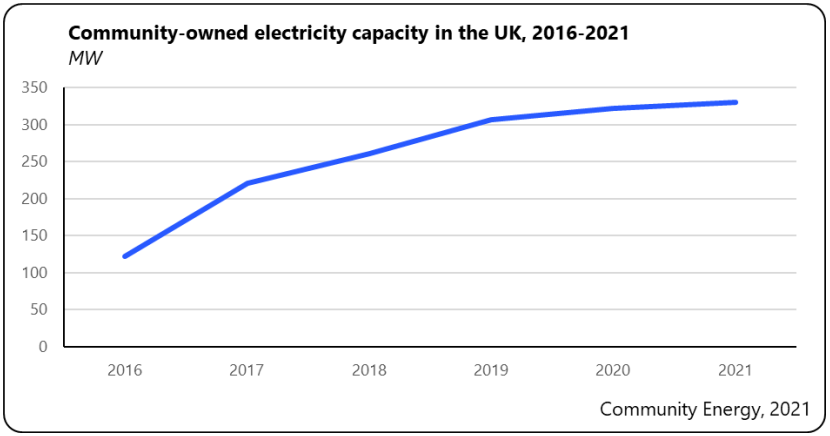
Figure 4.5 - Community-owned electricity capacity in the UK, 2016-2021581
849. Government should commit to the Local Electricity Bill that would enable community energy projects to provide energy directly to local households and businesses, and work directly with the sector to create a Community Energy Strategy. This should consider legislative, regulatory, funding and capacity barriers in the sector, and should create a comprehensive plan to turbocharge the sector. Central government should also consider what support it can give to innovative community-level energy projects such as community purchasing and community energy sharing and storage.
CASE STUDY: South East London Community Energy (SELCE) Selce is a community energy group that places as much emphasis on supporting people to be more energy efficient and tackling fuel poverty as it does on generating renewable energy. It uses social business models to meet the needs of people in the local area across the wealth gradient. Since its inception in 2014, Selce has provided one-to-one advice to thousands of low-income households struggling with their bills. For example, from August 2021-August 2022 they provided one-to-one support to 1,079 low-income households in South East London, all of which were struggling with their bills and half of which have a long-term disability or illness. Selce helped residents get the best deal on their bills, access grants and discounts and reduce their energy demand. Its multilingual and multi-ethnic team focus on enabling long-term gains in energy efficiency and empowering residents to take control of their energy costs. In the same period, its work resulted in a summed reduction in costs of more than £600,000 and avoided more than 5 million kg of CO2. The Selce team delivers advice in a variety of settings: in homes, by phone and at drop-in energy cafes that are designed to incentivise and destigmatise energy advice. Over 12 months, the team delivered 53 workshops, visited nearly 400 homes, and reached over 500 residents. This included delivering more than 350 bags of simple, easy to install energy saving measures such as draught proofing, LED lightbulbs and water saving measures. Selce delivers advice in collaboration with other local organisations to ensure it reaches the most vulnerable residents. From August 2021-2022, they trained 103 front-line workers to better understand fuel poverty and embedded 10 energy advice volunteers in local organisations to deliver advice to their communities. Selce has also created its own social enterprise, Future Fit Homes, to work with those who are able to pay for energy efficiency measures. The Future Fit Homes project is working intensively with one street in Lewisham to enable residents to work together to retrofit their homes, as well as with the Royal Borough of Greenwich to support SMEs to reduce their costs and their carbon emissions. Selce owns and operates 510 kWp of community-financed solar PV across 11 sites, including seven schools, two leisure centres, one hotel and one church. These solar arrays collectively produce 438,730 kWh of solar electricity and avoid 84,654 kgCO2e annually. Selce is working on a pipeline of six sites. In partnership with neighbouring community energy group Sustainable Energy24, Selce has used community financing to support four schools to replace over 6,000 lights and light fittings.582 |
850. Another key aspect of community level energy is heat networks, sometimes called district heating. These are systems of insulated pipes that distribute heat from a central source around a variety of places such as homes and businesses, often recycling waste heat or heat from otherwise inaccessible sources and increasing energy efficiency.583 Heat network zoning is an approach that involves central and local government working with local industry and stakeholders to designate areas where heat networks can provide the lowest cost way to decarbonise heating.
851. Government should do more to support heat networks while ensuring that households and businesses are able to benefit from lower energy prices due to their efficiencies. This should include considering the use of innovative heat network technologies such as mine water heat projects or geothermal energy, and a particular focus on re-using waste heat.
CASE STUDY: Heat Networks Somers Town Energy Somers Town Energy is a district energy network between Euston and King's Cross stations that provides heating and hot water to over 600 homes, a new primary school and community facility, and power to the Francis Crick Institute, Europe's largest biomedical research facility. The project involved the retrofitting of a new low carbon energy centre within an existing council- owned car park, alongside new cycle parking facilities. The project has seen a reduction in energy costs for residents living in the social housing connected to the network, while contributing to Camden's zero carbon ambitions. Leeds PIPES The scheme will provide low carbon heat and hot water to 1,983 council homes which will save tenants money on their energy bills while reducing the city's carbon footprint. This project also has wider connotations for the community, providing local employment and training opportunities. So far, the project has helped to employ more than 430 people in the local low carbon sector - including 36 apprentices. It is also being used to educate local schools on climate change - with the Leeds PIPES network being named by a local academy.584 |