Public transport
Government should amend the regulatory framework to incentivise transport providers to increase demand and improve services, and that it works with them on this vision, by 2024. |
916. The Review has heard repeatedly that the expense of public transport is a deterrent to people. Public transport costs have risen faster than car travel since 2010.632 This particularly affects those on lower incomes, who are also less likely to own a car and so are more dependent on public transport. Transport poverty is not officially defined in the UK, but Green Alliance has argued that the number of people unable to "attain a socially and materially necessitated level of transport services [...] is almost certain to have increased during 2022" due to price rises and service cuts.633 When coupled with fuel poverty, this creates a "double energy vulnerability".634 By limiting people's ability to travel to jobs outside their immediate area, transport poverty can exacerbate the problem. For those who can afford to own and run a car, the costs of publictransport mean that there is little incentive to choose it even for journeys that could easily be done by train or bus. The coronavirus pandemic also had an unprecedented impact on how we travel, with public transport having recovered slower than car journeys. Many countries are now bringing down the costs of public transport to incentivise usage.
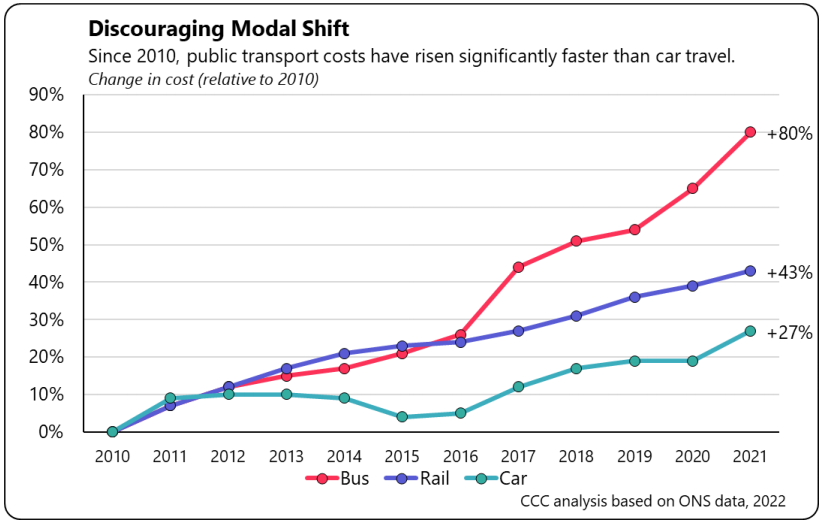
Figure 5.5 - Cost of public transport
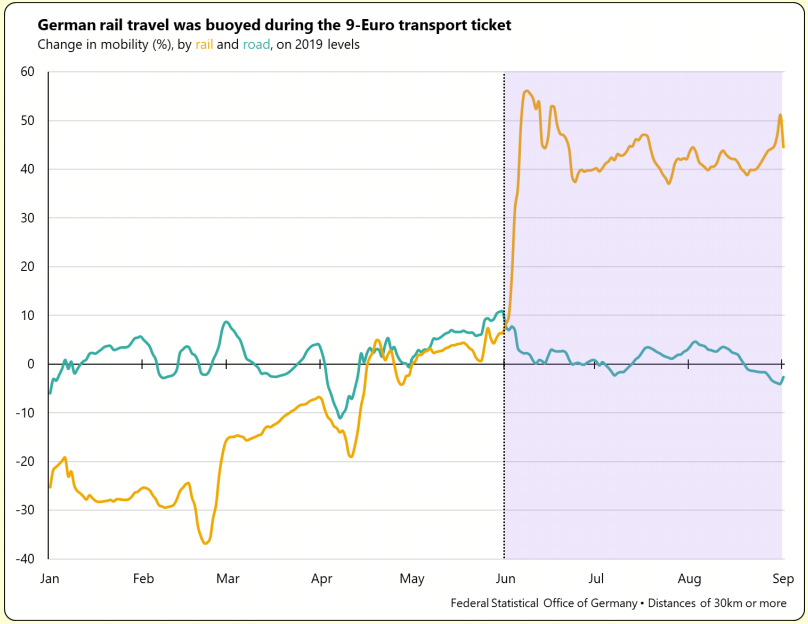
CASE STUDY: Germany's Deutschlandticket Germany have recently announced that unlimited regional public transport across the country will cost just €49 per month next year, with the aim of cutting emissions, helping with the cost of living and supporting domestic tourism. The Deutschlandticket' will cost around €3 billion per year and is funded by both federal and state governments. This follows a trial in which a monthly ticket for all public transport for three months cost just €9. The trial saw significant increased take up of public transport: over 52 million tickets were sold and, according to a survey by the Association of German Transport Companies (VDV), around 20% of users had rarely used public transport before, with around 10% of trips replacing journeys that would otherwise have been done in cars. 37% used it to travel to work. Emissions were reduced by about 1.8 million tonnes of CO2 and traffic jams were reduced in 23 of the 26 cities surveyed.635
Figure 5.6 - Germany case study |
917. Government must act to reduce the costs of public transport. Government recognised this in the Transport Decarbonisation Plan and has set an intention to make public transport better value and more competitively priced. Further action is still needed. The House of Lords inquiry into net zero and behaviour change heard that reduced costs could be delivered through a reprioritisation of funding away from large road and major infrastructure projects, as well as from new revenue-raising measures.636
918. The Review heard that there is a gulf between public transport services offered in some regions compared to others. As well as costs increasing, the volume of services on offer has been reduced in many areas, again affecting lower income households most. This is also likely to present particular challenges for people travelling with children, and disabled people, who often require more space than other passengers. 28% of people surveyed by Opinium thought that transport options could be improved.637 Many countries are enhancing their public transport networks. Paris will soon have Europe's largest Metro network, with the Grand Paris Express. Germany is investing an additional €35 million in improving and expanding Berlin's public transport system. Pillar 4 sets out how local communities across the UK could become '15- minute neighbourhoods.' The government should learn from the initiatives other countries have implemented to reduce public transport costs and consider how funding reprioritisation could help to deliver this in the UK.
919. Long-term finance is also required for initiatives to decarbonise the existing transport fleet. In response to the review, businesses highlighted the value of initiatives like the Zero Emission Bus Regional Areas (ZEBRA) schemes, which has helped businesses and local authorities to roll-out zero emission vehicles. However, there remains uncertainty about what future support will be available.
920. Government should amend the regulatory framework to incentivise transport providers to increase demand and improve services, and that it works with them on this vision, as set out in the government's plan for Great British Railways.