6.1.2 The sector today
1020. Through its world-leading university and research sector, the UK is well positioned to play an important global role in net zero R&D and technology innovation.720 Of the actions that must be taken to deliver on the UK's 2035 decarbonisation ambitions, 84% requires low carbon technologies or fuels in combination with behavioural change (Figure 6.1).721 The Climate Change Committee (CCC) has estimated that additional capital investment into low carbon technologies and infrastructure needs to reach £50-£60 billion per year by the early 2030s to meet the UK's net zero targets.722
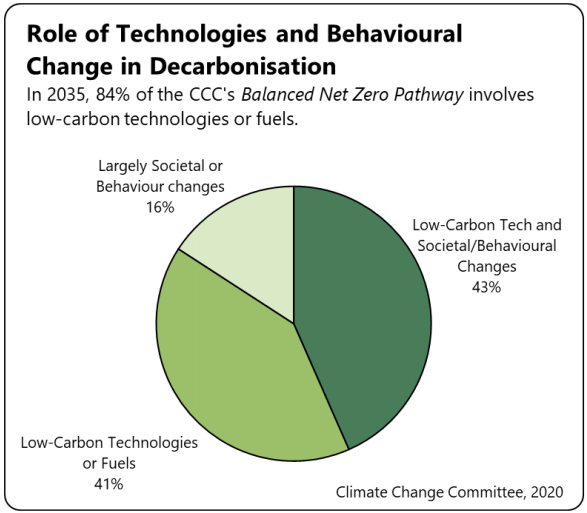
Figure 6.1 - Role of technologies and behavioural change in decarbonisation
1021. Technological innovation is pivotal to sustained economic growth - and to avoid putting difficult asks on the population. Forthcoming research from the Government Office for Science's Net Zero Society study demonstrates that achieving net zero without new technology would require significant societal changes which may not be acceptable to all.
"While science and technology alone cannot achieve net zero, we shall not achieve net zero without science and technology". - Royal Society723
1022. The UK can capitalise on the economic growth opportunities from R&D. Members of the Council for Science and Technology (CST), who include leading voices from academia and business, told the Review that if the UK can maintain and scale-up R&D and support emerging technologies to market, it stands in a strong position to create high-growth and wage industries for net zero into and beyond 2050:
"The net zero space is forecast to be a significant growth area as carbon-neutral solutions ramp up towards government targets and new technologies come online. Research and innovation supporting and enabling net zero for the UK can and will deliver a series of benefits in meeting our economic growth target of 2.5% a year" - Council for Science and Technology members.724
1023. The UK has recognised this potential and placed an emphasis on supporting innovation in net zero. Agencies including UK Research and Innovation (UKRI) and Innovate UK support a range of net zero innovations. The Catapults network (a network of technology and innovation centres established by Innovate UK) have been successful in bridging the gap between early- stage research and commercialisation by investing over £2.5 billion to move innovations towards commercial stages. For example, the Offshore Renewable Energy Catapult network was integral in supporting subsea cable manufacturer JDR Cables to bring its pioneering 66kV cable technology to market, allowing increased transmission between turbines at higher- capacity offshore wind farms. This has been a factor in reducing offshore wind costs and created hundreds of roles.725
1024. The Government recognised the importance of the R&D and technology sector for net zero in its 2021 Innovation Strategy, acknowledging that the net zero target was a pivotal moment for the UK's future prosperity. The strategy committed to increasing annual public investment in R&D to a record £22 billion. This was accompanied by publication of the Net Zero Research and Innovation Framework, which provides a first statement of the key research and innovation to prioritise over the next 5-10 years and will be further complemented by a delivery plan. Moreover, the Government's Net Zero Innovation Board provides £1 billion of funding to accelerate the commercialisation of low-carbon technologies and infrastructures.