6.4.2 Reforming the UK ETS
1065. The UK ETS has a cap set on the total amount of certain greenhouse gases that can be emitted by sectors covered within the UK ETS scheme. With the cap on total emissions set to decrease over time, this provides a clear signal to businesses to invest in decarbonisation as the cost of ETS allowances is likely to increase as the cap is reduced. The current legislated ETS cap only runs until 2030, and, as the Climate Change Committee (CCC) emphasised in its advice on the Sixth Carbon Budget in December 2020,762 it is not aligned to delivering net zero by 2050.
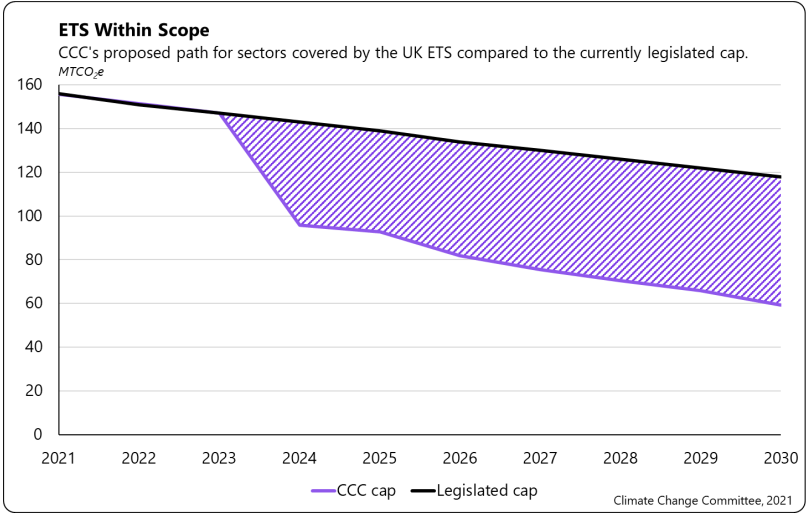
Figure 6.4 - CCC's proposed path for emissions for sectors covered by the UK ETS, as per their updated 2021 advice, compared to the currently legislated cap763
1066. Following these recommendations, the UK ETS Authorityxli has committed to making this adjustment by 2024 by aligning the cap with net zero and the interim Carbon Budget targets for covered sectors. The Authority published a consultation in March 2022 and the market is expecting this change. The Review has heard a mixed signal from industry stakeholders with regards to whether these changes are already factored in by industry. This reflects the need for ongoing engagement and clarity by the Government on emerging plans.
1067. In addition to making the cap net zero aligned, the Authority is also consulting on expanding the UK ETS to the domestic maritime sector by the mid-2020s and has launched a Call for Evidence to expand the UK ETS to waste and energy from waste by the mid- to late-2020s. Through adding these sectors, up to an additional 12MtCO2exlii of current UK annual emissions could be covered by the UK ETS, depending on scope of the scheme.764 For waste specifically, we have had stakeholder feedback that an important barrier to their investment in green technologies is the lack of a carbon price on their emissions. With an investment horizon of more than 15 years, the Government needs to provide policy stability to the sector.
1068. The consultation also suggests accounting for investments in greenhouse gas removals (GGRs) to the UK ETS. Adding GGRs into the UK ETS could help establish the demand for carbon removal measures by providing a mechanism for companies with existing ETS obligations to use of removals in addition to emissions reductions by 2050. The longevity, integrity and long-term policy certainty offered by the UK ETS provides a credible commitment to future demand for GGRs. Including GGRs would evolve the ETS so that it becomes a market framework within which businesses can make economically efficient choices between paying to emit, paying to sequester, or investing to lower emissions. This requires government to set clear guidelines for how and when GGRs can be utilised alongside emissions reduction efforts. An integrated market framework could sustain net zero - or net negative - beyond 2050 whilst enabling growth. The UK Government has not yet taken a final decision and UK ETS integration should be considered alongside other ways to support GGRs, taking fiscal impacts into account.
______________________________________________________________________________
xli The UK ETS Authority is composed of the UK Government, Scottish Government, Welsh Government and Northern Ireland Executive.
xlii 12 MtCO2e is made of 6 MtCO2e for maritime transport and 6.4 MtCO2e for energy from waste.