6.4.3 The UK ETS beyond 2030
| By 2024, Government should work within the UK ETS Authority to develop a pathway for the UK ETS until 2040. This pathway should: • Set out a vision on the future design and operation of the ETS • Set out a timeline for expanding the coverage to the rest of the UK economy, as well as sectors consulted on including maritime and waste. • Address inclusion of GGRs to incentivise early investment in new technologies and potentially nature-based solutions. • Provide reassurance to businesses around how the Government will mitigate the risk of carbon leakage as a result of expanding the ETS. |
1069. Government needs to be clear about the future of the UK ETS beyond 2030. While some initiatives in the consultation, such as the inclusion of GGRs, speak to futureproofing the UK ETS, there is currently no legislated cap or government strategy for what the UK ETS should look like beyond 2030 and even the road leading to 2030 is not clear for businesses currently. The feedback the Review has received from industry has consistently been that lack of clarity and certainty on the future of the UK ETS, combined with lack of certainty on carbon leakage measures (see above), contribute to delays in investments.
1070. This lack of certainty and clarity about the future of the UK ETS risks delaying investment in green technologies. The Authority's current approach of consulting on and introducing changes with two to four years' notice lacks the long-term price signal which could provide clarity for businesses to invest in long-term decarbonisation solutions and as such new green technologies.
1071. The UK ETS needs to expand to new sectors. HM Treasury acknowledged in the 2021 Net Zero Review765 that widespread carbon pricing can apply a consistent incentive across all sectors of the economy, allowing the private sector to decide how to decarbonise most efficiently across sectors, and to do it at minimal cost. As such, the Authority should make clear an intention to expand the UK ETS beyond the sectors currently under consideration.
1072. By 2030, the current sectors covered by the UK ETS will only cover 18 % of UK territorial emissions766 and as the table below shows, sectors such as agriculture and international aviation and shipping will continue to increase their share of the UK's emissions towards 2050 as other sectors decarbonise. This highlights the need to expand the scope of the UK ETS in order to ensure a meaningful carbon market of sufficient magnitude and further encourage other sectors to decarbonise.
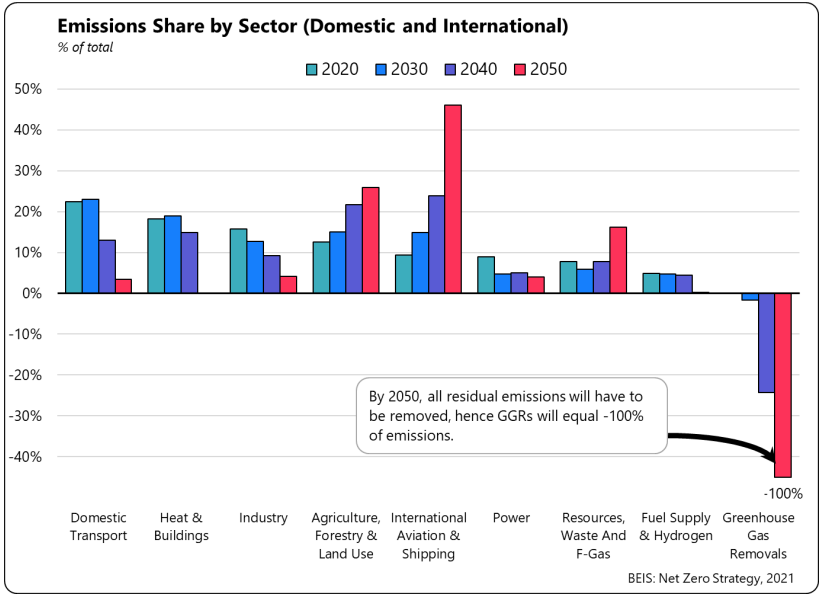
Figure 6.5 - Emissions share by sector: Domestic and international, 2020, 2030, 2040 and 2050767
1073. Following the pathway set out in the Government's Net Zero Strategy and used for this chart, the Government needs to consider expanding the UK ETS to sectors such as domestic transport and heat and buildings by 2030 as these sectors will continue to have a high share of the UK's territorial emissions. However, such a move should be followed by government measures to mitigate the impact of this policy on particularly low-income households and small businesses.
1074. Expanding coverage of the compliance carbon market to cover a larger proportion of the economy and emissions is something other countries have done. Surrender obligations (the obligation to pay the auctioned price for one's emissions) under the New Zealand ETS currently covers 50% of the country's greenhouse gas emissions768 and transitional arrangements are in place to bring the agriculture sector in by 2025 (see case study below). Similarly, the EU is currently negotiating the EU ETS II to cover transport and buildings. This is meant as a transitional measure to bring these sectors into the main ETS market and additionally raises funds to protect households from increased prices.
| CASE STUDY: The New Zealand ETS The New Zealand Emissions Trading Scheme was launched in 2008, but has undergone considerable reforms since, so it today covers a broad range of sectors; power, industry, buildings, transport, aviation, waste, and forestry. The most recent reforms included removal of the previous price ceiling and a new cap on unit supply which must be aligned with the country's economy-wide emissions budget. Biological emissions from agriculture must be reported, but the sector currently faces no surrender obligation. Agricultural emissions will have a carbon price levied from 2025, either through the ETS or a separate pricing scheme. The New Zealand ETS also allows the generation of credits from removal activities which are forecast to generate credits worth 16.5 million tonnes CO2 (or equivalent in other greenhouse gases) in 2022, primarily from forestry activity.769 |
1075. To provide businesses with certainty and increase the incentives to invest in new, green technologies, the Government should work within the UK ETS Authority to develop a pathway for the UK ETS until 2040 by 2024. This pathway should:
a) Set out a vision on the future design and operation of the ETS
b) Set out a timeline for expanding the coverage to the rest of the UK economy, as well as sectors consulted on including maritime and waste.
c) Address inclusion of GGRs to incentivise early investment in new technologies and potentially nature-based solutions.
d) Provide reassurance to businesses around how the Government will mitigate the risk of carbon leakage as a result of expanding the ETS.