Overall finding in this section
19. Relationships between, and the behaviours of, parties to PFI Contracts are generally reasonable, but with pockets of poor behaviour existing. In our view the pockets of poor behaviour are unacceptable and the public and private sectors should show corporate leadership and be willing to challenge poor behaviour wherever it occurs.
20. Those pockets of poor behaviour may be a proximate cause of some disputes, issues and/or poor relationships, but the root cause is typically an underlying disagreement on the performance of the relevant PFI project.
21. When considering the pathway to achieving stronger performance, the key issue for the parties to consider is the extent to which the chosen route may have a detrimental effect on relationships between the parties. In other words, can a non-confrontational pathway be mapped out, or is a degree of confrontation needed to achieve that performance improvement. This is entirely within the giftof both parties to consciously decide.
22. The chart set out in Figure 1 below summarises the main options for the parties to a PFI Contract when faced with addressing issues of poor performance. Arrows in red illustrate the confrontational pathway that is difficult, where behaviours will suffer, and money will "leak out sideways" on legal costs and disputes. Arrows in green illustrate the pathway where collaboration is maintained on that journey to better performance, with significantly less wasted cost.
Figure 1: Relationships v. Performance in Operational PFI Contracts
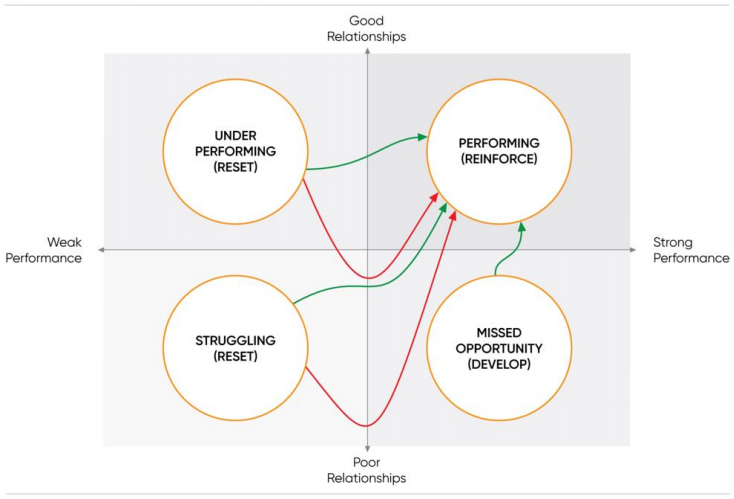
23. Any decision on which pathway to take must be a conscious one, to avoid inadvertently slipping into a confrontational pathway. Currently, in our view, too many projects are reported as adopting the "red" route. We believe, and recommend in Section 4 of this report, that the public sector should be willing to incentivise the private sector to improve performance quickly and effectively, by embracing the opportunity to collaboratively "reset" relationships between the parties to PFI Contracts. We also believe that SPV Owners need to be pro-active in creating and seizing that collaborative 'green' pathway.
24. Although we did not share Figure 1 with any consultee or disclose to any consultee the identity of any other consultee that we had spoken to, we often received feedback from multiple parties to the same PFI project. When we reflected on this feedback, it was reasonably clear to us that if we had asked each consultee to point to the quadrant in Figure 1 that best described the relevant PFI project, the results would not have been consistent. This highlights a significant perception gap between the parties.