Section 5 There is a "reset" opportunity in the PFI market
1. Sections 1-4 of this report have set out a series of findings and recommendations. If implemented, they will improve behaviours and relationships considerably. This section sets out more detail on one of our key recommendations - the "reset" approach. The ''reset" approach represents an opportunity for a more fundamental overhaul of relationships across the PFI sector. Although this may sound bold, we believe such an overhaul is long overdue.
2. A type of "resetting" appears to be currently taking place in the health sector, although this seems to typically occur against a backdrop of the relevant Public Authority ramping up inspections and audits that have often led to some level of confrontation and break down of the relationship between the Public Authority and the SPV. As highlighted earlier in the report, this approach has been seen by some Public Authorities as being the only way to get a meaningful response from the SPV, albeit that it often leads to tense relationships and disputes, with wasteful pain and cost for all parties. We heard repeatedly from the public and private sectors that the confrontational approach soaked up too much scarce executive leadership time and typically required significant levels of external costs to be incurred.
3. The "reset" we are recommending represents an opportunity for the parties to move a PFI project into the "Reinforce" quadrant identified in Figure 1 set out in paragraph 22 of Section 1 above, but without the need for excessive cost or relationship capital being expended. In effect, the "reset" that we are recommending creates an environment for transparently dealing with issues and encourages a pro-active approach to both identification and remediation of issues. At a very high level, a "reset" would typically involve (i) a systematic review of asset/services; (ii) a rectification plan; and (iii) a degree of relief from Deductions to allow programmed rectification to take place.
4. Our "reset" approach is intended to be used proactively. It is a renaissance approach and is not intended to be used as a means of rescuing a failing PFI project. If an SPV only seeks a "reset" after the relevant PFI project has hit significant identified problems, then there is much less incentive for the Public Authority to offer relief during periods that issues are being rectified.
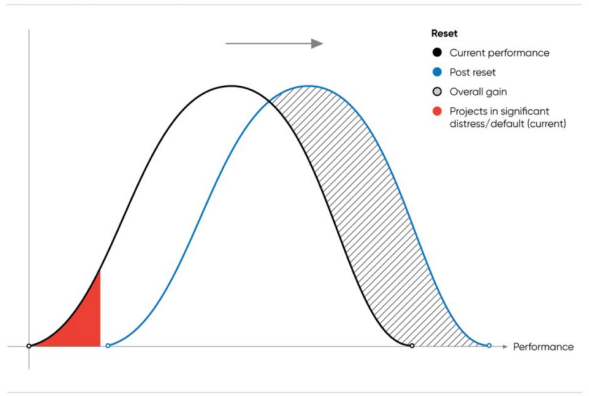
5. A "reset" is intended to deliver a significant shift in relative performance of the PFI Contract, moving the distribution curve to the right as set out below in Figure 2. There are some important points to note:
(a) This is not about perfection, a normal distribution of performance will likely remain, but the overall level of performance will generally be higher as a result of undertaking a "reset";
(b) PFI projects that are in significant distress or default, which will happen (and continue to
happen) for a variety of reasons, will need to continue to be worked through on a case by case basis.
(c) A "reset" won't remove the risk of a PFI project going into distress or default, but it will help reduce the frequency and likelihood of that happening.
Figure 2: The Opportunity Provided by a Reset
6. Based on the evidence that we collected during our review, we are satisfied that unless the "reset" approach is embraced by the public and private sectors, the pattern of behaviours that prompted this review is likely to continue and worsen. We would therefore encourage the IPA and SPV Owners to embrace the "reset" recommendation and lead the development of a template approach for a "reset".
7. To help the development of a template approach , we set out below some key features that should form part of any "reset" approach.
Key features of any "reset" approach:
A. General Considerations
■ The aim is to provide an opportunity for the SPV to review proactively the asset/service and implement an efficient rectification plan within a time limited period, during which relief from Deductions would be given.
■ This should be adopted as a renaissance approach, rather than one of rescue, providing an opportunity for a collaborative approach to improve performance.
■ Culturally, SPV Owners should feel incentivised to make the most of this one-off window of opportunity, and they should be encouraged to proactively seek to implement "resets".
■ On any PFI project, both the Public Authority and SPV Owners need to embrace the approach willingly - this is important to create the environment for greatest transparency and openness. There must be a commitment to collaborate.
B. Commercial Principles
■ SPVs and their supply chain incentivised to identify and declare every issue they know about, in order to benefit from 'amnesty'.
■ Survey commissioned to identify issues - joint appointment & jointly agreed scope, paid for by the private sector.
■ Consistency in "reset" approach, supported by frameworks/portfolio approach to make as efficient as possible.
■ Survey to be used to prepare schedule of action.
■ Any Health & Safety issues to be prioritised.
■ Period of Relief provided - agreeing to suspend Deductions for a period of a timetabled action plan to allow SPV to purposefully schedule and addresses issues:
❖ This in effect gives an extension of the existing 'excusing cause' in many Payment Mechanisms for planned/programmed maintenance.
❖ Payment Mechanism would continue to operate as normal for day to day issues.
❖ Where a PFI project already has significant issues then, although many of the same principles could apply, a pre-agreed commercial settlement, in effect a "block deduction", could be part of the commercial deal, rather than no Deductions.
■ Timetable has to be meaningful and cannot be elongated in order to allow all supply chain claims to be worked through post survey. SPV Owners to agree approach with their supply chain in advance.
■ Fast track dispute resolution for issues where views differ.
■ Active management arrangements by SPV Owners going forward to be part of review.
C. Potential for Additional Items to be Addressed
We would propose that these additional items could be considered on a project specific basis:
■ [Variations to incorporate elements of energy efficiency/decarbonisation.]
■ [Variations to address issues where over specification of service has been identified.]
■ [Speeding up variations.]
■ [Agreeing handback process.]
D. Governance
■ Consistent approach agreed centrally by IPA and Government Departments with SPV Owners.
■ Local ownership - corporate leadership to agree to adopt approach, have a shared view of the end point, and work with Nolan principles in implementation and in operational approach thereafter.
■ Ensure "Liaison Committees", or equivalent, are operating effectively to monitor progress, to be regular minuted meetings, tracking actions and responsive to any escalation of issues.
■ SPV Owners to consider benefits of inviting Public Authority officials to sit on the SPV's board of directors, or offer observer status at Board meetings